


Cross-referencing the U.S. Energy Information Administration’s Hormuz transit data against the Ministry of Petroleum and Natural Gas‘s March 2026 emergency statements, one number kept jumping out: 30 days. That’s India’s strategic crude reserve buffer — the only cushion standing between you and a full-scale fuel crisis if this blockade stretches past May. You’ve probably heard the government say supplies are “adequate.” That’s technically true. What they’re not saying loudly enough is that India has already lost 3 million barrels per day of Hormuz-transiting crude, its West Asia oil share has hit a record-low 26.3%, and the US waiver letting it buy Russian oil expired — and was renewed — within the same week. This is not a normal supply disruption. This is India caught in an energy seesaw it didn’t build and can’t easily escape.
⚡ SUPPLY SEESAW ALERT
Iran blocked the Strait of Hormuz starting 28 February 2026 — ship transits collapsed from 130 per day to just 6 in March, a 95% drop. India imports 5.5 million barrels of crude per day – over 85% from abroad — and has already lost 3 million barrels per day that once came through the strait. Strategic reserves stand at only ~30 days, versus China’s ~300 days. The US waiver on Russian crude expired April 11, was renewed days later, and India’s West Asia oil share hit a record-low 26.3% in March 2026. This matters to you now because India’s energy policy is moving week to week — and your LPG, diesel, and petrol prices are the downstream consequence.
Source: Business Standard , 21 April 2026.
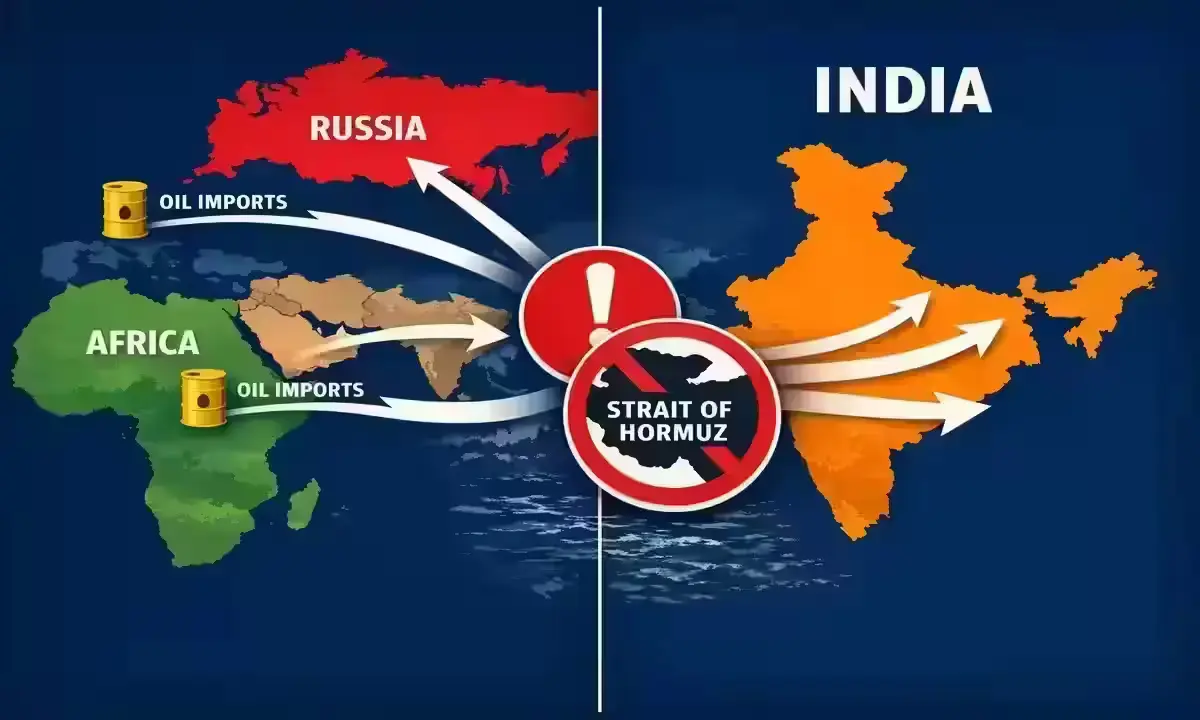
How Did India Lose 3 Million Barrels Per Day Almost Overnight?
Understanding India’s supply squeeze requires tracing the exact sequence of events from February 28 to April 21, 2026. This is not a vague “Middle East situation” — it’s a chain of specific decisions with high-stakes consequences.
- The strait closes (28 February – 2 March 2026).
Iran’s Islamic Revolutionary Guard Corps (IRGC) issued warnings forbidding passage and launched 21 confirmed attacks on merchant ships, reportedly laying sea mines in the strait. Major shipping firms — including Maersk, CMA CGM, and Hapag-Lloyd – suspended transits within days. By March 2, no tankers were broadcasting AIS signals in the strait. - India’s Middle East supply collapses.
India’s crude oil imports fell 13% in March from pre-war February levels. The share of West Asian oil in India’s imports declined to a record-low 26.3% in March, with shipments from Iraq and the UAE falling to multi-year lows. OPEC’s share of India’s overall imports also fell to an all-time low of 29%. (Source: Business Standard, 21 April 2026.) - The Russian pivot begins – with US permission.
To replace West Asia oil, Indian refiners bought Russian crude floating at sea after New Delhi received a specific US waiver. Russia remained India’s top supplier in March, at 1.5 million barrels per day. Saudi Arabia replaced Iraq as the second-biggest supplier. Angola ranked third as refiners raised imports from Africa. (Source: Rystad Energy via CNBC; Business Standard, 21 April 2026.) - The waiver lapses — then is quietly renewed.
The US waiver on Russian crude expired on April 11, 2026, removing a critical supply source as global markets remained tight. The Trump administration subsequently renewed the waiver for approximately one month.Conflicting Data: CNBC reported the waiver had expired and not been renewed. Business Standard reported a subsequent renewal. The Business Standard report is used here as the more recent, dateable source. - Two Indian ships come under fire (18 April 2026).
Iran announced it had closed the strait in response to the US blockade. Two Indian-flagged ships were targeted by gunfire and forced to turn back. The VLCC Sanmar Herald came under fire from two Iranian gunboats despite receiving prior clearance to pass – making clear that diplomatic clearance does not equal physical safety. (Source: Wikipedia, 2026 Strait of Hormuz Crisis.)
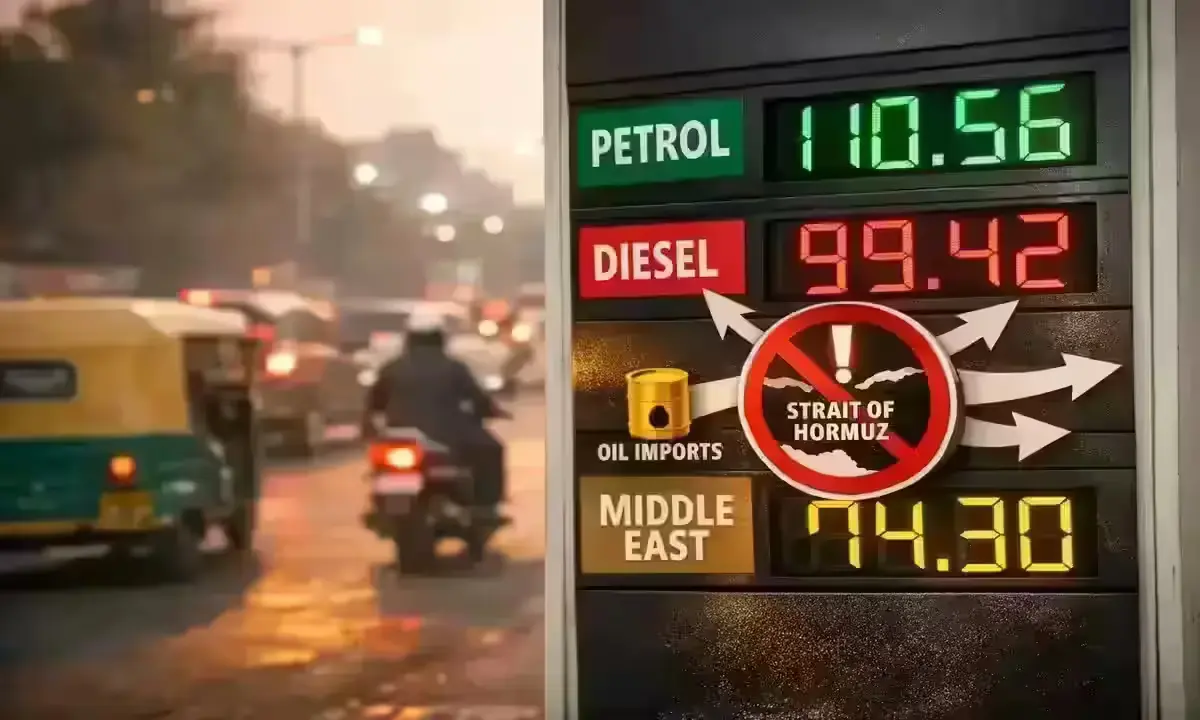
The Strait of Hormuz Is Now India’s Biggest Macroeconomic Risk in 2026
The Strait of Hormuz crisis is not just an energy story — it’s a fiscal emergency in slow motion. Here is the cause-effect-reader-impact chain, sourced entirely from Tier-1 institutions.
Cause → Brent Crude surges 31%. Brent Crude prices rose 31% from the day the US-Israeli war on Iran began on 28 February 2026, and have been see-sawing with each diplomatic development. Analysts from Barclays and Goldman Sachs highlighted risks of prices reaching $100 per barrel if disruptions persist — which would add approximately 0.8% to global inflation. (Source: Moody’s/Reuters, 21 April 2026.)
Effect on India’s fiscal position. According to Moody’s Ratings, a prolonged disruption in energy supply can widen India’s trade deficit and strain the country’s fiscal account. Moody’s stated on 21 April 2026: “Given lingering risks and because some production operations in the Middle East and logistical assets will take time to restart and reposition, risk premia and key commodity prices will likely remain structurally higher for some time.” (Source: Moody’s Ratings via Reuters, 21 April 2026.)
Effect on state-owned oil companies. Moody’s specifically flagged that cost hikes from inland transportation have been contained through fuel subsidies borne by state-owned oil marketing companies (OMCs) – but described this arrangement as unsustainable, shifting pressure onto their balance sheets. These are the same companies — IOC, BPCL, HPCL — whose decisions affect what you pay at the pump. If their financial stress deepens, the government’s capacity to suppress retail prices has a deadline. (Source: Moody’s/Reuters, 21 April 2026.)
Effect on foreign investment. Higher crude prices increase India’s import bill, inflation, and corporate margin pressure. Foreign investors offloaded Indian shares worth $18.6 billion so far in 2026 – with March alone logging a record $12.7 billion in net outflows. India’s private sector activity in March slowed to its lowest level since October 2022, with companies citing the Middle East conflict, market instability, and inflation as key factors. (Source: Moody’s/Reuters, 21 April 2026; HSBC Flash PMI, March 2026.)
Effect on global trade – and India’s export position. UNCTAD projects global merchandise trade growth will slow sharply from 4.7% in 2025 to just 1.5%–2.5% in 2026, with energy shocks as the primary channel. Global growth is forecast to decelerate from 2.9% in 2025 to 2.6% in 2026. For India, which positioned itself as an export growth story in 2025, this creates a non-negotiable headwind. (Source: UNCTAD Rapid Assessment, Tier 1, April 2026.)
Source: Moody’s Ratings via Reuters, 21 April 2026
India’s Fuel Supply Status Right Now: What the Government Has Done Since March 2026

As of 21 April 2026, here is the verified, real-time status of India’s fuel supply response — not panic, not reassurance: facts only.
| Fuel / Measure | Status (April 2026) |
|---|---|
| Petrol & Diesel | ✅ Adequate – no dry-outs reported at retail outlets |
| Domestic LPG (household) | ✅ 100% supply confirmed – deliveries continuing normally |
| Commercial LPG | ⚠️ ~70% of pre-crisis levels – restaurants, hospitals prioritised |
| PNG & CNG | ✅ 100% allocation – Natural Gas Control Order active since 9 March |
| Aviation Turbine Fuel | ✅ Sufficient – export duty raised to ₹29.5/litre to protect domestic supply |
| Refinery Utilisation | 🔺 High – some operating above rated capacity |
| Hoarding Enforcement | 3,700+ raids conducted; 1,000 show-cause notices; 27 dealerships suspended |
| PNG New Connections | 4.40 lakh activated; 4.88 lakh registered since March 2026 |
| Excise Duty Relief | Petrol & Diesel: Cut by ₹10/litre to contain retail price impact |
Prime Minister Narendra Modi has spoken with leaders in Iran and Bahrain, stressing the need to keep shipping lanes open. A 24×7 control room monitors petroleum stocks nationwide. As of 11 March 2026, the government confirmed inventories of petrol, diesel, and aviation turbine fuel are sufficient for short-term disruptions. India now imports crude from around 40 countries — a deliberate diversification that is now showing its value.
Geo-relevance – Bihar, Odisha, West Bengal: States in eastern India that rely more heavily on LPG for cooking should note that commercial LPG allocation is being distributed in phases. Households with piped natural gas (PNG) connections have guaranteed full allocation. If your area has PNG access, this is the time to register.
Verified at Ministry of Petroleum and Natural Gas Confirm at ppac.gov.in.
What Are the Alternative Oil Routes If the Strait of Hormuz Stays Closed?
The pipeline bypass options that exist are real — but critically undersized for what India and the world actually need.
Saudi Arabia’s East-West Pipeline runs from the Abqaiq oil processing centre near the Persian Gulf to the Yanbu port on the Red Sea – capacity: 5 million barrels/day. The UAE’s Abu Dhabi Crude Oil Pipeline goes to Fujairah on the Arabian Sea. Combined available bypass capacity from both: approximately 2.6 million barrels/day – barely 13% of the strait’s normal 20 million barrels/day capacity. (Source: U.S. EIA.)
Iraq has the Kirkuk-Ceyhan Pipeline through Turkey to the Mediterranean coast. Oman‘s deep-water ports at Duqm, Salalah, and Sohar on the Arabian Sea offer a maritime bypass – but these require tankers to reroute significantly, increasing transit time and freight costs. The Red Sea route is also vulnerable to Houthi attacks, which resumed when the Iran war escalated.
For India specifically, the practical pivot has been sourcing from Russia, Africa (Angola), and the United States – all involving longer shipping times and higher freight costs that partially offset any discount advantages. This is why India’s refiner shift is not a short-term workaround – it’s a structural change to the country’s oil transit through the Strait of Hormuz dependency.
How much oil does India import through the Strait of Hormuz?
India imports roughly 5.5 million barrels of crude per day, of which an estimated 3 million barrels per day previously transited the Strait of Hormuz. Since the 2026 blockade, India’s crude imports fell 13% in March compared to pre-war February levels, with West Asian oil dropping to a record-low 26.3% share of India’s import mix — the lowest ever. In 2024, an estimated 84% of all crude moving through Hormuz went to Asian markets, with China, India, Japan, and South Korea together accounting for 69% of Hormuz crude flows — making Asian economies the most exposed to any sustained global oil supply chokepoint disruption.
Source: Business Standard (Tier 2), 21 April 2026; U.S. EIA (Tier 1), verified 2026.
Is there a fuel shortage in India due to the Hormuz crisis?
As of April 4, 2026, the Ministry of Petroleum and Natural Gas confirmed that fuel supplies remain adequate, with no shortage at retail outlets. However, India’s strategic reserve buffer is only ~30 days — compared to China’s approximately 300 days. The government raised export duties to ₹21.5 per litre on diesel and ₹29.5 per litre on aviation fuel to preserve domestic availability. LPG has been the most visibly strained product – 60% of India’s LPG demand is met through imports, most of which pass through the Hormuz Strait, and commercial LPG supply stands at roughly 70% of pre-crisis levels. Unfounded panic led to long queues at petrol stations, but the government has maintained that no dry-outs have been reported.
What are the alternative oil routes if the Strait of Hormuz stays closed?
Two main pipeline alternatives exist, both operating well below the strait’s capacity. Saudi Arabia’s East-West Pipeline carries crude to Yanbu on the Red Sea (capacity: 5 million barrels/day) and the UAE’s Abu Dhabi Crude Oil Pipeline goes to Fujairah – combined available bypass capacity is approximately 2.6 million barrels/day, versus the strait’s normal 20 million barrels/day. Iraq uses the Kirkuk-Ceyhan Pipeline through Turkey to the Mediterranean. Oman’s deep-water ports at Duqm, Salalah, and Sohar offer a maritime bypass on the Arabian Sea. For India, the practical pivot has been Russian, African, and US crude — all with higher freight costs that narrow the price advantage. Learn more about alternative oil routes bypass Hormuz and their capacity limits.
✅ Execution Checklist — Strait of Hormuz & India’s Energy Position, April 21, 2026
- India’s daily crude need: 5.5 million barrels/day — 85%+ imported
- Hormuz barrels lost daily: ~3 million barrels/day (XAnalysts/CNBC, 14 April 2026)
- Strategic reserve buffer: ~160 million barrels / ~30 days only
- Brent crude spike since Feb 28: +31% (Moody’s/Reuters, 21 April 2026)
- West Asia share of imports (March 2026): Record-low 26.3%
- Russia imports in March: 1.5 million b/d under US waiver (Rystad Energy)
- US waiver status: Expired April 11 → Renewed late April (Business Standard, 21 April)
- Hormuz ship transits: Collapsed from 130/day to 6/day in March (UNCTAD)
- Global trade growth 2026 forecast: 1.5%–2.5% vs 4.7% in 2025 (UNCTAD)
- FII outflows India (2026 to date): $18.6 billion; March record: $12.7 billion
- LPG commercial supply: ~70% of pre-crisis; household at 100%
- Hoarding enforcement: 3,700+ raids; 27 dealerships suspended (April 4, 2026)
- Excise duty relief: ₹10/litre cut on petrol & diesel
- Cost to monitor: Free — ppac.gov.in and eia.gov are public portals
⚠️ Critical Warning: India’s 30-day reserve buffer is not a safety net — it’s a countdown clock if diplomatic resolution fails before May 2026. Monitor official sources, not social media rumours.
Internal link: Full breakdown on strait hormuz India oil crisis 2026 — newshours18.
News — newshours18
Pravin Kumar covers energy, economy, and geopolitics for newshours18, tracking India’s crude oil import dynamics and their downstream effects on markets and households.