

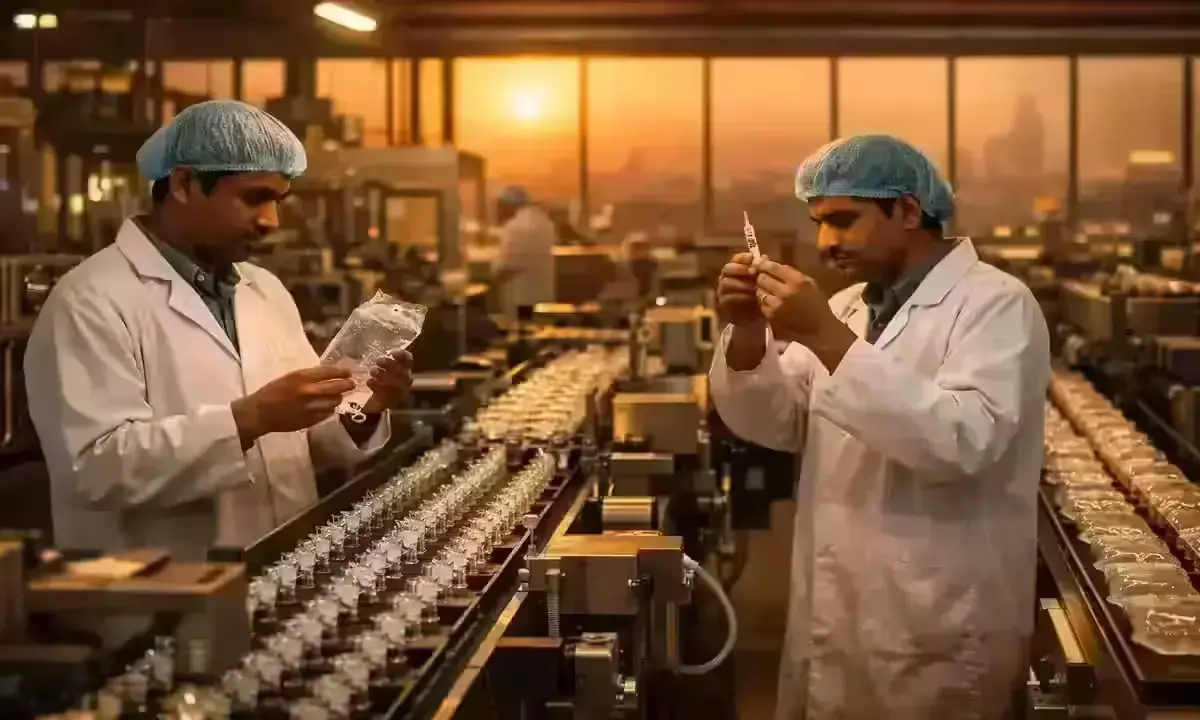
[SUPPLY: UNDER SIEGE]
Why India’s Medical Device Industry Is Bleeding Money Because of West Asia’s War in 2026
After speaking with domestic manufacturers in Faridabad, Visakhapatnam and Punjab in the third week of March 2026 – through ground-level reports filed – one thing was immediately clear: the Strait of Hormuz doesn’t feel like geopolitics on a factory floor. It feels like a raw material invoice you can’t pay.
Here’s the counterintuitive part: India’s medical device industry isn’t being hurt by bullets – it’s being hurt by polymers. The same petrochemical pipelines that feed cooking gas cylinders also supply the polypropylene for your hospital syringe, the PVC for your IV bag, and the silicone oil for your condom. When the Hormuz choke point slams shut, it doesn’t just turn off the gas — it turns off an entire materials ecosystem.
Your hospital bills are about to feel it. Your pharmacist probably already does.
What’s Happening, Who’s Hit and What It Means for You – Right Now
- The trigger: US-Israel strikes on Iran on 28 February 2026 effectively closed the Strait of Hormuz – the world’s most critical energy chokepoint – for the first time in recorded history.
- The cost shock: Critical plastic input costs for medical devices have surged nearly 50%. Gas prices (Adani Total Gas) have doubled since early March 2026.
- The victims: Manufacturers of syringes, catheters, surgical gowns, IV sets, condoms, and dental implants across Faridabad, Visakhapatnam and Punjab are the front-line casualties.
- The ask: AiMeD – the Association of Indian Medical Device Industry – has formally demanded a 3-month customs rebate of 2.5% on raw materials and 5% on components from the Ministry of Commerce and Industry.
- The timeline: Even if Hormuz normalises, industry expects 2 to 4 months before input costs begin to stabilise.

What Should Indian Medical Device Manufacturers Do Right Now?
The Association of Indian Medical Device Industry (AiMeD) has already moved. But if you’re a manufacturer, a hospital procurement officer, or an investor tracking this sector – the question isn’t just “what’s happening?” It’s “what do you actually do about it?”
Here are five concrete, actionable steps that industry leaders are already executing or demanding:
Step 1: Formally document your cost spike and submit it to AiMeD.
AiMeD wrote to both the Ministry of Finance and the Ministry of Commerce and Industry in mid-March 2026 — but that letter carries more weight when backed by aggregated, documented cost data from actual manufacturers. If your business has experienced polypropylene prices rising ₹15–23/kg or PVC rising ₹13,000/tonne, submit your cost logs to AiMeD. This is how the industry body builds a verified case for government relief. Without documentation, relief demands are anecdotal.
Step 2: Apply immediately for the proposed 3-month customs duty rebate under Chapter 90 – and prepare your paperwork now.
AiMeD has specifically demanded a temporary 2.5% rebate on raw material imports and 5% on component imports under Chapter 90 of the customs tariff. The Ministry has not yet formally announced this relief as of 29 March 2026. But when it does — and industry expects it will — the companies with paperwork ready will benefit first. Engage your customs broker and compliance team now, not after the gazette notification drops.
Step 3: Contact the Container Corporation of India (CONCOR) directly about inland haulage charge rationalisation.
This is a non-obvious lever. AiMeD wrote to Commerce Minister Piyush Goyal specifically requesting rationalisation of inland haulage charges by CONCOR. For manufacturers receiving imported raw materials at inland container depots, this charge has become a meaningful cost multiplier. File a formal request citing the current geopolitical disruption — companies that raise this formally are more likely to get temporary rate relief under the Essential Commodities framework.
Step 4: Initiate a polymer supplier audit and diversify away from Gulf-linked feedstocks immediately.
Bio-Med HealthCare in Faridabad uses medical-grade polypropylene from refineries that have redirected gas to cooking fuels and CNG. Reliance Industries has implemented multiple steep polypropylene price hikes since early March 2026. The key move: identify suppliers with non-Gulf polymer feedstocks — including Korean, European, and US-origin alternatives — even if they cost more today. The supply risk of single-source dependency is now far larger than the cost premium of diversification.
Step 5: Demand fast-track GST refunds – this is a cash-flow survival move, not a long-term ask.
AiMeD’s letter to Piyush Goyal explicitly flagged fast-track GST refunds as a priority relief measure. Manufacturers are currently spending significantly more on inputs while receiving delayed refunds on exports and inter-state supplies. If your GST refund claims are pending, escalate them now with a formal letter citing the current supply chain emergency — the government has acknowledged this crisis, and IRS officers at field level have discretion to prioritise flagged claims.
Field Note: Here’s what most generic coverage misses – the pain isn’t uniform. Large multinationals with 6-month polymer stockpiles are largely insulated. The real damage is concentrated in small and medium manufacturers who run 30–45 day inventory cycles. The Visakhapatnam surgical gown manufacturer who raised prices from Rs 80 to Rs 120 a piece had no buffer. He had to absorb the full polypropylene shock within days.
Common Mistake: Waiting for a formal government relief announcement before diversifying your polymer supplier base. Relief, if it comes, addresses cost — it does not address supply continuity. Manufacturers who wait may find that by the time duties are reduced, the polymer they need is simply unavailable from their existing Gulf-linked supplier.
How One Closed Strait Broke India’s Entire Medical Manufacturing Chain
 The macro shift has a specific date: 28 February 2026. That is the day US and Israeli forces struck Iran, and the world’s most consequential shipping chokepoint — the Strait of Hormuz — effectively shut down to commercial vessels for the first time in recorded history.
Understanding why this matters for a syringe factory in Faridabad requires a two-step explanation that most news articles skip.
Cause → Effect → Reader Impact
Cause: The Strait of Hormuz carries 20% of global crude oil, 20% of natural gas, and 20% of LPG flows. India is acutely exposed – 90% of its LPG imports pass through this strait, and imports cover 60% of India’s total LPG demand. In January 2026 alone, India produced 1.158 million tonnes of LPG domestically but imported 2.192 million tonnes – numbers confirmed by the Petroleum Planning & Analysis Cell (PPAC), Government of India.
Effect: When Hormuz closed, three supply chains snapped simultaneously. First, LPG imports dried up, triggering the well-reported cooking gas crisis. Second, petrochemical complexes – which use gas as feedstock to produce polypropylene, PVC and polyethylene – were ordered under the government’s Natural Gas Control Order of 9 March 2026 to redirect all hydrocarbon streams to LPG production. Medical-grade polymer production collapsed. Third, Adani Total Gas notified industrial customers that gas supplies would be limited to 40% of daily contracted amounts – slashing energy available for factory production.
The polymer price cascade worked as follows:
- 6 March 2026: Polypropylene up ₹15/kg; LLDPE and HDPE up ₹15,000/tonne
- 10 March 2026: PVC up ₹13,000/tonne
- 11 March 2026: Polypropylene up another ₹23/kg; LLDPE/HDPE up ₹20,000–24,000/tonne
Taken together, plastic input costs for the medical device sector rose nearly 50% within three weeks of the war’s start. (Source: Indian Practitioner, March 2026.)
Reader Impact: Deepak Arora of Bio-Med HealthCare in Faridabad – supplying syringes, IV cannula, catheters, and dialysis products to hospitals — saw raw material costs rise 40% to 60% in this window and raised prices to hospitals by 5–25% depending on the product. Jagmeet Bahri, VP of Pivot Implants in Punjab, imports titanium from Switzerland; rupee depreciation compounded the disruption to push dental implant prices from Rs 10,000 to Rs 12,500 per piece within three weeks. (Source: Scroll.in, 25 March 2026.)
India’s medical device sector employs more than 5 lakh workers. It was valued at $15.35 billion in 2023 and projected to reach $50 billion by 2030 – per IBEF (India Brand Equity Foundation, a trust under the Department of Commerce, Ministry of Commerce and Industry). That trajectory is now under serious threat if the cost shock extends beyond the 2–4 month stabilisation window that Rajiv Nath, Forum Coordinator of AiMeD, has flagged as the minimum recovery timeline.
Expertise Note: Medical device manufacturers don’t use commodity-grade polypropylene. They use biocompatible, medical-grade polypropylene that can be sterilised using heat – a tightly regulated, high-spec material sourced from a narrow pool of certified suppliers. When the broader polymer market tightens, this grade tightens disproportionately – because a syringe made from non-medical-grade PP fails sterilisation standards. Even if commodity polypropylene prices partially recover, medical-grade supplies may remain constrained for longer. Generic market analyses miss this entirely.
Where the Medical Device Crisis Stands as of 29 March 2026
As of Sunday, 29 March 2026 – four weeks into the West Asia war – here is the precise, timestamped situation:
The government’s official position (as of 26 March 2026, Ministry of Petroleum and Natural Gas): No energy emergency declared. Domestic LPG output has been ramped up 40% to 50,000 tonnes per day – covering over 60% of India’s daily requirement of approximately 80,000 tonnes. An additional 800,000 tonnes of assured LPG cargoes are in route from the US, Russia, and Australia. India has expanded its energy import network from 27 to 41 countries.
The industry’s position (as of 27 March 2026, AiMeD via BusinessToday): Medical device input costs remain 50–60% elevated for plastics and over 20% elevated for packaging and self-generated power. Prices have already been raised by 10–20% and further revisions are likely in April 2026. Manufacturers are managing on buffer stocks — but those buffers have a finite horizon.
The condom manufacturing crisis (as of 27 March 2026): HLL Lifecare Ltd, Mankind Pharma Ltd, and Cupid Ltd – India’s three key condom producers – are grappling with the unavailability of silicone oil (PDMS) and a 40–50% surge in ammonia prices. Both are critical inputs. Ammonia stabilizes latex; silicone oil acts as lubricant. Production and order execution have been directly affected.
Act Now: If you are a medical device manufacturer, AiMeD urges filing your cost-impact documentation before 31 March 2026 to be included in the next representation to the Ministry of Commerce and Industry. Contact AiMeD via their official portal. GST refund escalations should similarly be filed before Q1 closes.
Official government status: Ministry of Petroleum and Natural Gas, press release, 26 March 2026. Confirm at mopng.gov.in for real-time updates.
Is there actually a shortage of syringes and medical devices in Indian hospitals right now?
Not yet – but the buffer is thinning. As of 26 March 2026, Rajiv Nath of AiMeD has confirmed there is no current shortage of syringes or other medical disposables. Manufacturers have managed shipment delays of 1 to 3 weeks through existing inventory buffers. However, this is a conditional assurance: if the Strait of Hormuz disruption extends beyond 4–6 weeks, buffer stocks will be exhausted, production will slow, and hospital procurement costs will rise further. Prices have already increased 10–20% across most medical disposables. You are not seeing empty shelves — but you are paying more, and that spread is widening weekly.
Critical Warning: The “no shortage” assurance specifically covers consumables like syringes and catheters. It does not apply to specialized inputs like medical-grade titanium for dental and orthopaedic implants, where the Hormuz blockade and rupee depreciation have already created supply constraints — and price hikes are already live on the ground.
Why are cooking gas cylinders and condom prices linked to the same war?
Because both are downstream of the same petrochemical supply chain. The Strait of Hormuz doesn’t just move crude oil – it moves the feedstocks for plastics, lubricants, and chemicals. The West Asia war, which began 28 February 2026, closed this chokepoint and forced India’s refineries and petrochemical plants to redirect all available gas to LPG cooking fuel production under the government’s LPG Control Order of 8 March 2026. This redirected feedstock away from polymer production, causing polypropylene and PVC prices to spike – the same polymers used in syringe barrels, IV bags, surgical gowns, and condom packaging foils. Silicone oil (PDMS), used as a condom lubricant, is a petrochemical derivative similarly impacted. The war hit one chokepoint; the supply chain transmitted that shock across dozens of product categories simultaneously.
Pro Tip: The fastest way to track when India’s medical device cost crisis begins to normalize is to watch domestic polypropylene benchmark prices from Reliance Industries – not official government statements. When PP prices start declining week-on-week, input costs for medical consumables will follow within 2–3 weeks.
What relief is the government actually offering to medical device manufacturers?
As of 29 March 2026, no formal relief has been announced specifically for medical device manufacturers. AiMeD has formally requested a temporary 3-month customs duty rebate of 2.5% on raw material imports and 5% on component imports under Chapter 90 of the customs tariff. The industry body has also asked Commerce Minister Piyush Goyal for rationalisation of CONCOR inland haulage charges and fast-track GST refunds. The government’s public focus has been on the broader LPG and energy crisis – the specific medical device relief demand is live but awaiting a formal response. Rajiv Nath of AiMeD stated in March 2026 that a targeted customs rebate is “a feasible and targeted policy intervention that can provide immediate relief.
Critical Warning: Do not wait for a formal Ministry announcement before preparing for this rebate. The customs duty rebate, if approved, will likely be retrospective in application – but the application windows under such instruments are typically short (days, not weeks). Manufacturers who do not have their import classification under Chapter 90 clean and documented will lose out.
The 2026 Bottom Line
| Action / Fact | Detail |
|---|---|
| War Start Date | 28 February 2026 — US-Israel strikes on Iran |
| Chokepoint Closed | Strait of Hormuz — first time in recorded history |
| Medical Device Plastic Cost Spike | Nearly 50% for polypropylene, PVC, and related polymers |
| Gas Price Change | Adani Total Gas supply cut to 40% of contracted amounts; PNG prices doubled |
| Manufacturer Price Hike (Live) | 10–20% increase across syringes, catheters, surgical gowns |
| Specific Product Data | Surgical gowns: Rs 80 → Rs 120 (Visakhapatnam); Dental implants: Rs 10,000 → Rs 12,500 (Punjab) |
| AiMeD Relief Demanded | 2.5% rebate on raw materials + 5% on components (Chapter 90); fast-track GST refunds; CONCOR haulage relief |
| Relief Status | Formally requested — not yet approved as of 29 March 2026 |
| Cost Stabilisation Estimate | 2–4 months post-Hormuz normalisation (Rajiv Nath, AiMeD) |
| Condom Sector Status | HLL Lifecare, Mankind Pharma, Cupid Ltd: silicone oil (PDMS) unavailable; ammonia up 40–50% |
| Official LPG Response | Domestic output up 40% to 50,000 tonnes/day; 800,000 MT secured from US, Russia, Australia |
| India Medical Device Market Size | $15.35 billion (2023); projected $50 billion by 2030 (IBEF, Dept of Commerce) |
| ⚠️ Critical Warning | No current shortage of syringes — but prices are rising. Titanium-based implants already affected by supply constraints. |
| Track Live Updates | mopng.gov.in |