

[PAN: RULES RESET]
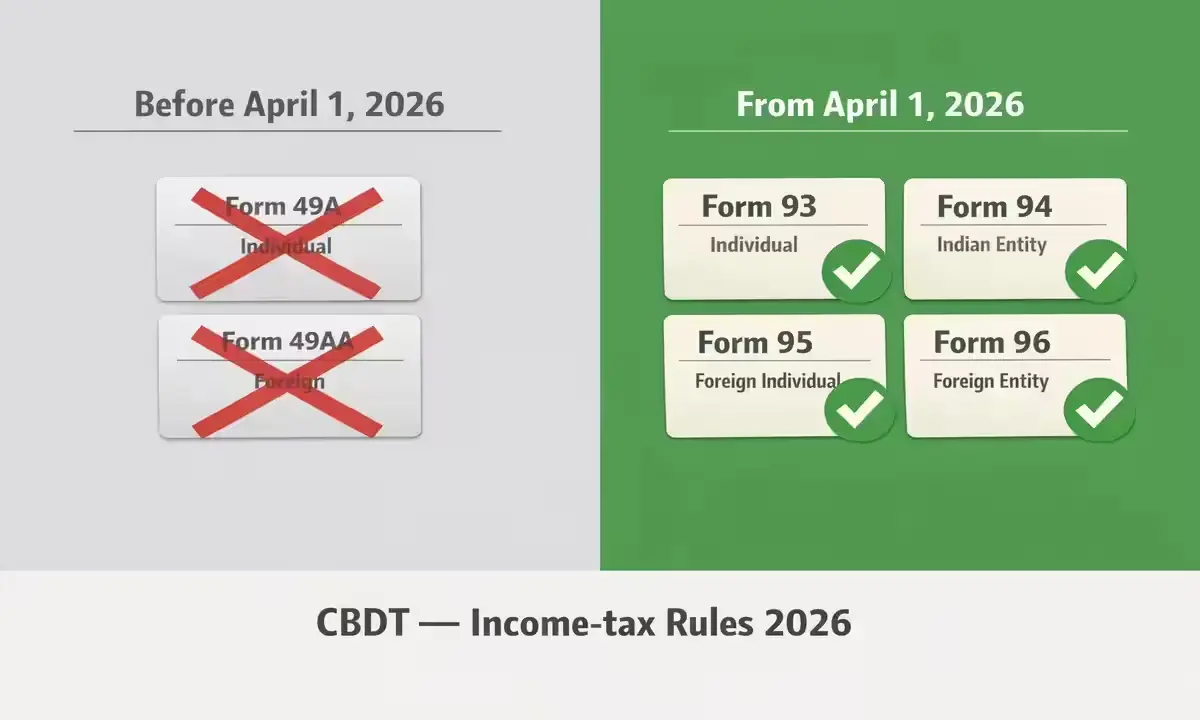
- Form 49A is officially retired — replaced by Forms 93 (individuals), 94 (Indian entities), 95 (foreign individuals), and 96 (foreign entities). Any application on the old form submitted after April 1, 2026 will be rejected by Protean and UTIITSL.
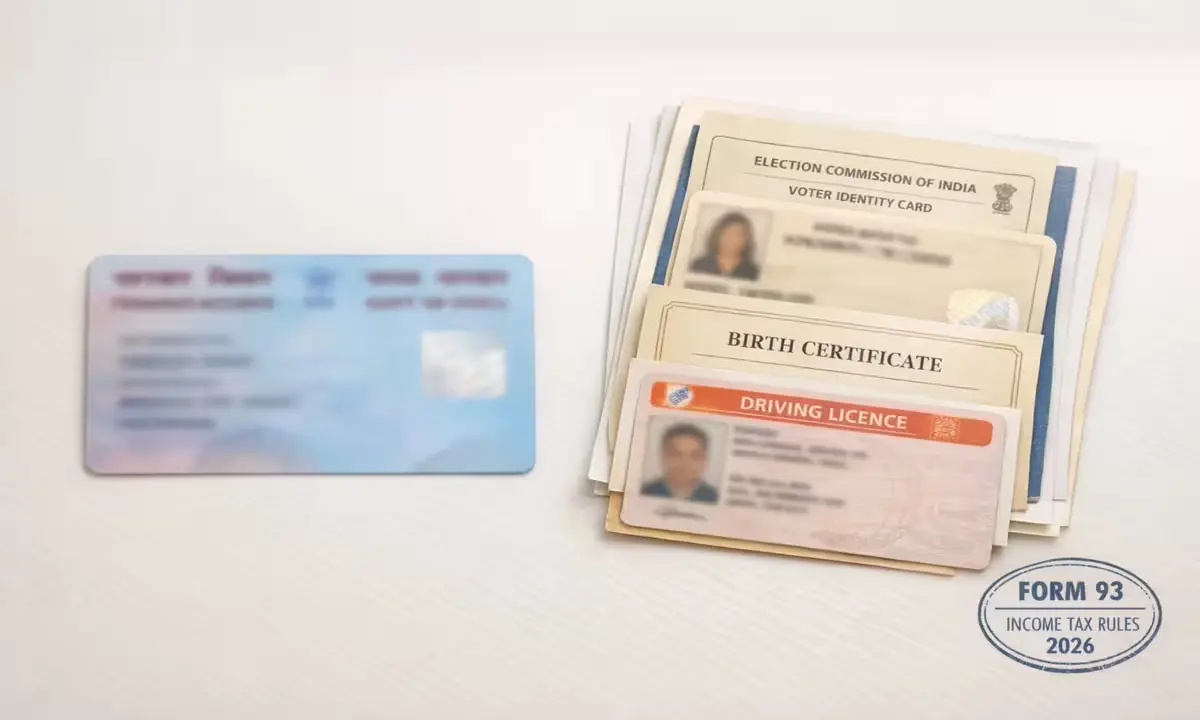
- Aadhaar alone is no longer enough — every new PAN application now requires an additional document proving Date of Birth: birth certificate, voter ID, passport, driving licence, or Class 10 marksheet.
- Your PAN name will mirror your Aadhaar name — exactly. If your Aadhaar has initials instead of a full name, your PAN will too. Fix Aadhaar first, or live with a legally binding mismatch.
- Cash transaction monitoring flips from daily to annual — the limit jumps from ₹50,000 per day to ₹10 lakh aggregate per FY. Small cash deposits no longer trigger PAN requirements. Large ones — tracked across the year — still do.
- NRIs with Indian passports use Form 93 — not Form 95 — your citizenship determines your form, not your country of residence. This is the single most common error in widely circulated articles on this topic.
Source: CBDT Gazette Notification — Income-tax Rules, 2026, verified April 2, 2026.
PAN Rules 2026: Old vs New – Complete Comparison
| Rule / Requirement | Old Rule (Pre-April 1, 2026) | New Rule (From April 1, 2026) |
|---|---|---|
| PAN Form — Indian Individuals | Form 49A | Form 93 |
| PAN Form — Indian Companies / Entities | Form 49A | Form 94 |
| PAN Form — Foreign Individuals | Form 49AA | Form 95 |
| PAN Form — Foreign Entities | Form 49AA | Form 96 |
| Sole Document for Application | Aadhaar alone — valid | Aadhaar alone – NOT valid. Additional DOB document mandatory. |
| Aadhaar as DOB Proof | Accepted | Not accepted |
| Name on PAN | As per application | Must exactly match Aadhaar database |
| Cash Deposit/Withdrawal — PAN Limit | ₹50,000 per day (per transaction) | ₹10 lakh aggregate per financial year |
| Motor Vehicle Purchase — PAN Limit | All vehicles, any value | Only if price exceeds ₹5 lakh |
| Hotel / Restaurant / Event — PAN Limit | ₹50,000 | ₹1 lakh |
| Immovable Property — PAN Limit | ₹10 lakh | ₹20 lakh |
| Governing Legislation | Income Tax Act, 1961 + Rules, 1962 | Income Tax Act, 2025 + Rules, 2026 |
Source: CBDT Gazette Notification – Income-tax Rules, 2026; Income Tax Department official portal, verified April 2, 2026.
How Do I Apply for a New PAN Card Under the New Rules – Step by Step?
High-intent search: “how to apply new PAN card form 93 april 2026”
The PAN application process hasn’t disappeared – it’s been restructured. Here’s exactly how to navigate it under the Income-tax Rules, 2026, effective now.
Step 1: Confirm which form you need before you open any portal.
The most critical first step. If you’re an individual Indian citizen, your form is Form 93. If you’re an Indian company, HUF, firm, or trust, use Form 94. Foreign individuals who do not hold an Indian passport must use Form 95. NRIs who do hold an Indian passport use Form 93 – citizenship governs the choice, not residency. Using the wrong form is the single most common reason for rejection under the new framework. Do not skip this step.
Step 2: Fix your Aadhaar details before you touch the form.
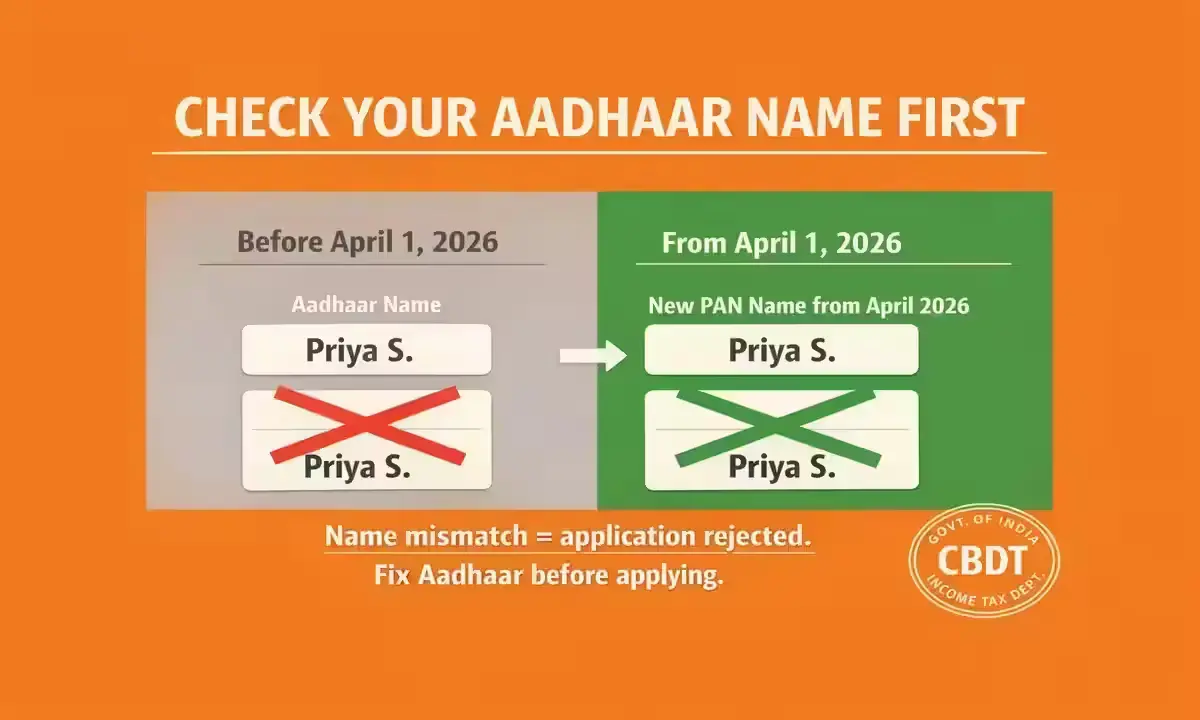
From April 1, 2026, the name on your PAN card will be generated exactly as it appears on your Aadhaar – including shortened initials, missing surnames, or spelling variations. If your Aadhaar has “Ramesh K.” instead of “Ramesh Kumar,” that’s what your PAN will say. Update your Aadhaar at the nearest Aadhaar Seva Kendra or online at myAadhaar (myaadhaar.uidai.gov.in) before filing the PAN application. This is a non-negotiable pre-check.
Step 3: Gather your Date of Birth document – Aadhaar alone will not do.
Under the new rules, Aadhaar is no longer accepted as DOB proof. You must submit one of: a Birth Certificate, Voter ID (EPIC), Passport, Driving Licence, or Class 10 Board Certificate (Matriculation). Have the original and a scanned copy ready before you open the application portal. Missing this document is the second most common rejection trigger.
Step 4: Access the application via Protean or the e-Filing Portal — not third-party aggregators.
Visit either Protean eGov (protean-tinpan.com) or the Income Tax e-Filing Portal (incometax.gov.in). On the e-Filing portal: scroll to PAN Card Services → Select “Apply for New PAN Card (Form 93 or 94 for Indian citizens).” Fill personal details — first name, middle name, last name, date of birth, mobile, email — exactly as they appear on your Aadhaar. Any deviation will cause a mismatch flag.
Step 5: Submit the application and track your e-PAN.
After submission, you’ll receive an acknowledgement number via SMS/email. e-PAN is typically delivered within 2–3 working days. Physical PAN card dispatch takes 15–20 days. Fee: ₹66–72 for e-PAN; ₹1,017 for international dispatch. The process is fully automated — no branch visit required.
🔎 Field Note: Cross-referencing the CBDT Gazette Notification (Income-tax Rules, 2026) against TaxGuru’s published FAQ for Form 93/94/95/96 (April 2026) reveals a nuance absent from most mainstream articles: applications pending as of March 31, 2026 under the old forms remain valid and will continue to be processed. Only new applications filed from April 1 onwards must use Form 93/94/95/96. You do not need to resubmit a pending application.
Common Mistake: Treating the “Aadhaar-based e-KYC” option on the portal as equivalent to the old Aadhaar-only route. e-KYC via Aadhaar OTP is still available as a verification method — but it does not replace the mandatory DOB document requirement. You still need to upload a DOB-proof document separately. Confusing e-KYC verification with document submission will cause your application to be flagged as incomplete.
Source: CBDT Gazette Notification – Income-tax Rules, 2026 (Tier 1); Income Tax Department official FAQ, Form 93
Why the New PAN Rules Signal a Bigger Shift in India’s Tax Architecture
Cause: On August 12, 2025, Parliament passed the Income Tax Act, 2025 – replacing the Income Tax Act, 1961, which had governed Indian taxation for six decades. On March 20, 2026, the CBDT officially notified the Income-tax Rules, 2026 via gazette notification — the operational rulebook that makes the Act functional from April 1. The PAN changes are a direct output of this legislative reset. Finance Minister Nirmala Sitharaman asked tax officials to hold public awareness sessions across India in local languages, signalling that the government anticipated significant ground-level confusion.
Effect: The new framework repositions PAN from a tax-filing identifier into India’s universal financial identity layer. The shift from daily-threshold monitoring (₹50,000/day for cash) to annual-aggregate monitoring (₹10 lakh/year) is not a relaxation — it’s a smarter surveillance model. The tax department no longer needs to flag individual small deposits; it tracks cumulative cash flows across the entire financial year. Simultaneously, crypto exchanges are now mandated to share transaction data with the tax department, and Central Bank Digital Currency (CBDC) has been recognised as an accepted electronic payment mode — both signalling that PAN is being integrated into India’s emerging digital money infrastructure.
Reader Impact: If you run a small business, operate a cash-heavy trade, or manage family finances with frequent bank deposits — your behaviour needs to recalibrate around annual totals, not individual transactions. A ₹1 lakh monthly cash deposit (₹12 lakh annually) now crosses the PAN-mandatory threshold by August of FY 2026-27. Plan your banking calendar accordingly from April. For critical financial commitments – home loan disbursement, FD renewal, investment account activation – ensure PAN status is active and correctly linked to Aadhaar before proceeding.
Expertise Note: KPMG’s GMS Flash Alert 2026-051 (March 3, 2026) flags a detail most consumer-facing articles miss: the Income-tax Rules, 2026 introduce mandatory Form 157 for individuals leaving India who do not have a PAN (either because their income is below the basic exemption limit or they are otherwise exempt from obtaining one). This is a new compliance obligation with zero equivalent in the old 1961 framework. If you’re planning to emigrate, travel for work abroad, or repatriate funds, the PAN/Form 157 question needs to be resolved before departure – not at the airport.
Today Is April 2, 2026 – Here’s What’s Live Right Now on PAN
The new PAN rules are not scheduled — they are active. As of today, April 2, 2026, every PAN application submitted via Protean or the Income Tax e-Filing Portal is being processed under the new Income-tax Rules, 2026. Form 49A submissions are being rejected. Aadhaar-only applications are being rejected. The system has flipped.
Protean eGov Technologies and UTIITSL have both updated their online portals to reflect Form 93, 94, 95, and 96 as the only valid application forms as of April 1, 2026. Users attempting to access the old Form 49A workflow are being automatically redirected. If you applied before March 31 and received an acknowledgement number, your application remains valid under transitional provisions — you do not need to reapply. If you haven’t applied yet, the new process is the only process.
The Income Tax Department’s official Aadhaar-PAN linking status tool remains active and critical. Any taxpayer with an inactive PAN (due to failed Aadhaar-PAN linking) cannot file returns, cannot claim refunds, and will attract higher TDS rates on transactions. Under the new Act’s implementation, this compliance gap becomes more costly — not less.
Act Now: If your Aadhaar details (name, date of birth) do not precisely match what you intend to use on your PAN application, update your Aadhaar at myaadhaar.uidai.gov.in or the nearest Aadhaar Seva Kendra before your next PAN-related action. Aadhaar correction typically takes 3–7 days to reflect. Do not file a new PAN application with a pending Aadhaar correction in progress.
Verified at CBDT Gazette Notification – Income-tax Rules, 2026, April 2026. Confirm current portal status at incometax.gov.in for real-time updates.
Conflicting Data: Several widely circulated articles state “NRIs must use Form 95.” Livemint, Goodreturns, and the Income Tax Department’s official Form 93 FAQ clarify that this applies only to foreign nationals and non-citizens of India. NRIs who hold Indian passports — i.e., citizens of India who are non-resident — must use Form 93, not Form 95. The determining factor is citizenship, not residential status. We have used the Income Tax Department’s official Form 93 definition under Rule 158 of Income-tax Rules, 2026 as the authoritative source. Applying Form 95 when Form 93 is required will result in rejection.
FAQ: New PAN Rules 2026
Can I still use Aadhaar as the only document to apply for a PAN?
No – the Aadhaar-only PAN application route closed permanently on March 31, 2026. From April 2, 2026 onwards, every fresh PAN application must include an additional document proving Date of Birth. Aadhaar is no longer accepted as a DOB proof under the Income-tax Rules, 2026 — it can still be used as identity verification via e-KYC OTP during the application process, but cannot substitute a standalone DOB document. Acceptable DOB documents include a birth certificate, voter ID, passport, driving licence, or Class 10 matriculation certificate. Applications missing this document will be returned as incomplete by both Protean and UTIITSL. Applicants who submitted before March 31 under the old system are not affected — their applications will be processed under transitional provisions.
Critical Warning: Do not confuse Aadhaar-based e-KYC (an OTP verification step) with the old Aadhaar-only application (where Aadhaar was the sole document). The portal still offers e-KYC verification – but this does not satisfy the DOB document requirement. Submitting without a DOB-proof document will result in rejection even if e-KYC verification succeeds.
Source: CBDT Income-tax Rules, 2026; Income Tax Department official FAQ, Form 93, Rule 158 , verified April 2, 2026.
What’s the new limit for quoting PAN when depositing cash at a bank?
From April 1, 2026, PAN is mandatory only when your total cash deposits or withdrawals aggregate ₹10 lakh or more across all bank accounts in a financial year. This replaces the old rule — where any single cash deposit or withdrawal exceeding ₹50,000 per day required PAN. The shift from a per-transaction threshold to an annual aggregate fundamentally changes how the tax department tracks cash flows. A one-time large deposit still crosses the limit. But multiple small deposits — say ₹80,000 twice a month — only trigger the PAN requirement once the annual total crosses ₹10 lakh.
Pro Tip: The ₹10 lakh limit is calculated across all your bank accounts combined — not per account. If you have accounts at SBI, HDFC, and a co-operative bank, the tax department’s Annual Information Statement (AIS) aggregates your deposits across all three. Don’t distribute cash deposits across multiple accounts expecting to stay below the threshold per account — the system sees total flow, not per-branch flow.
Source: CBDT Gazette Notification – Income-tax Rules, 2026; verified April 2, 2026.
My Aadhaar has a shortened name – will it affect my new PAN?
Yes – from April 1, 2026, the name on your PAN card will be generated exactly as it appears in the Aadhaar database, including initials, shortened versions, or missing surnames. The Income-tax Rules, 2026 mandate direct name synchronisation between Aadhaar records and new PAN issuances. If your Aadhaar says “Priya S.” instead of “Priya Sharma,” your PAN card will say “Priya S.” — and that name becomes your legally recognized financial identifier for ITR filing, bank KYC, property transactions, and all other PAN-mandatory activities. Fix the source document — not the PAN form.
Pro Tip: Aadhaar name correction requires a supporting document (birth certificate, school certificate, or gazette notification for official name changes). The correction typically takes 3–7 business days to reflect. File the Aadhaar correction request before initiating your PAN application. Once the new PAN is issued with an incorrect name, correcting it requires a separate PAN correction application — more time, more documents, more steps.
Source: Income Tax Department official FAQ, Form 93, Rule 158, Income-tax Rules, 2026, verified April 2, 2026.
The 2026 Bottom Line
| Action | Detail |
|---|---|
| New form – Indian individuals | Form 93 (replaces Form 49A) |
| New form – Indian entities | Form 94 |
| New form – foreign individuals | Form 95 (NRIs with Indian passport → use Form 93) |
| New form – foreign entities | Form 96 |
| Aadhaar-only route | CLOSED from April 1, 2026 |
| Mandatory DOB documents | Birth certificate / Voter ID / Passport / Driving licence / Class 10 certificate |
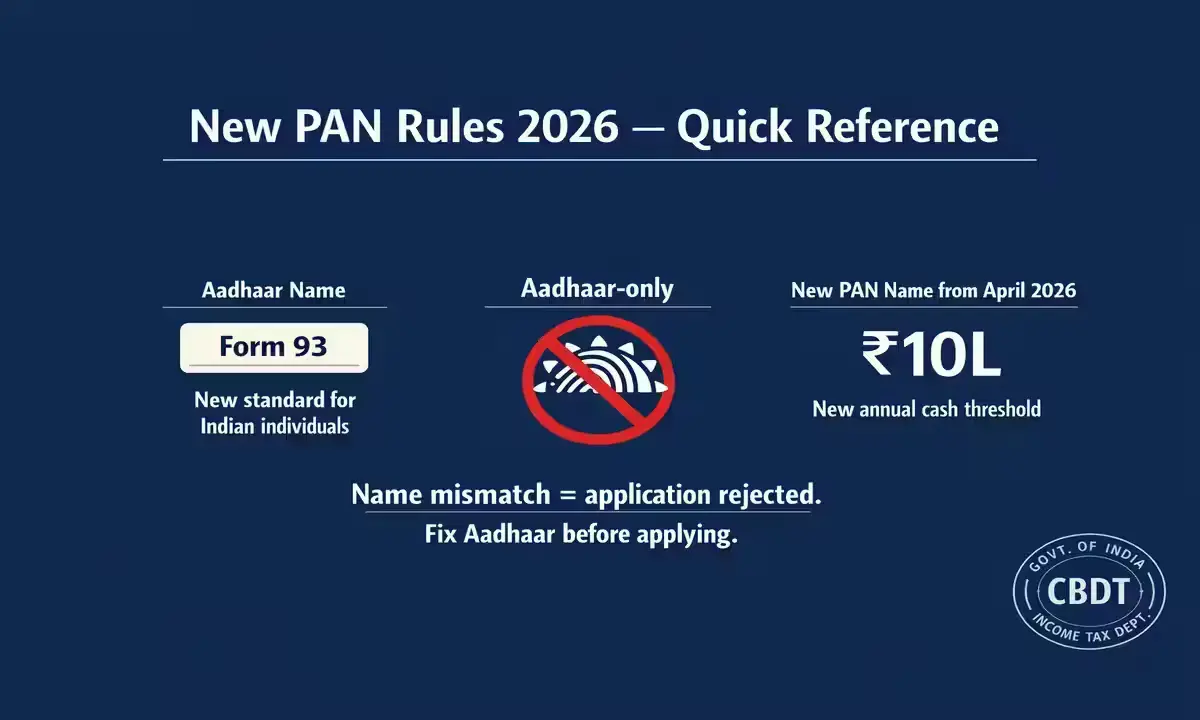
| Name on PAN | Must exactly match Aadhaar name — fix Aadhaar first |
| Cash deposit/withdrawal PAN limit (new) | ₹10 lakh aggregate per FY (was ₹50,000 per day) |
| Vehicle purchase PAN limit (new) | ₹5 lakh and above (was all vehicles) |
| Hotel/event PAN limit (new) | ₹1 lakh (was ₹50,000) |
| Property transaction PAN limit (new) | ₹20 lakh (was ₹10 lakh) |
| Application fee – e-PAN | ₹66–72 (unchanged) |
| Application fee – international dispatch | ₹1,017 (unchanged) |
| e-PAN delivery time | 2–3 working days |
| Physical PAN card delivery | 15–20 days |
| Governing authority | CBDT — Central Board of Direct Taxes |
| Governing legislation | Income Tax Act, 2025 + Income-tax Rules, 2026 |
| Official application portals | protean-tinpan.com / incometax.gov.in |
| Critical warning | Old Form 49A and 49AA rejected from April 1. Aadhaar-only applications rejected. NRIs with Indian passports must use Form 93, not Form 95. |
| CTA | Apply for new PAN / check application status at incometax.gov.in |