


When Will Pension FDI Hit 100%: NPS Trust Separation and What It Means for 2.2 Crore Subscribers in 2026
By Pravin Kumar Finance
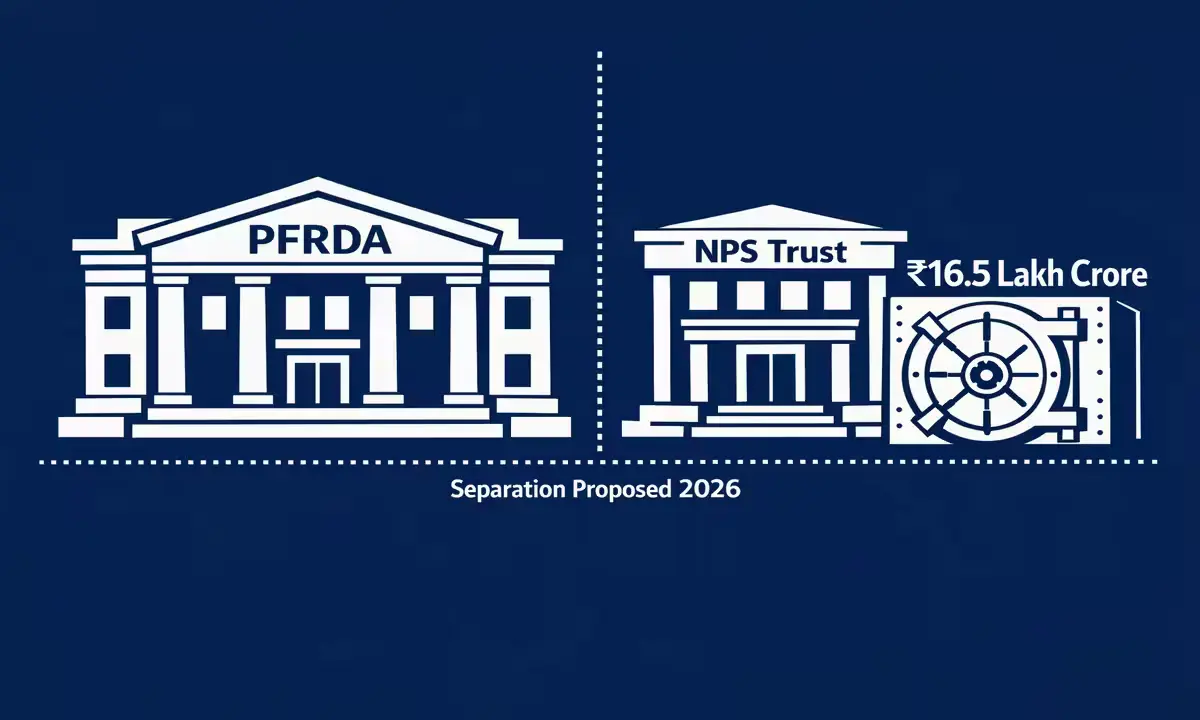
Your NPS account is about to get a structural overhaul most people haven’t been told about yet. Coverage is stopping at the headline — “pension FDI to rise from 49% to 100%.” What it misses is the second, more significant change buried in the same proposed amendment: NPS Trust will be separated from PFRDA, and the ₹16.5 lakh crore retirement corpus will be governed under an entirely different legal framework.
Cross-referencing the PFRDA (National Pension System Trust) Regulations 2015 against the April 19, 2026 government briefing (PTI), these two changes — FDI liberalisation and structural separation — are being packaged together for one Parliament session. That is not a coincidence. That is high-stakes policy engineering — and it affects every rupee you have parked in NPS right now.
POLICY SHIFT IMMINENT
When it moves – The amendment bill is expected in the Monsoon Session or Winter Session 2026, subject to internal approvals.
Who it restructures – The NPS Trust, which holds ₹16.5 lakh crore in AUM on behalf of ~2.2 crore subscribers, will be separated from PFRDA and placed under the Companies Act or a charitable trust framework.
Board composition – The new NPS Trust board will have 15 members, majority from the government — the largest contributor to the corpus.
Why it matters to you – More foreign capital in pension funds means competitive fund management and potentially better long-term returns on your retirement corpus.
Source: PTI via Asia Insurance Post, PFRDA Portal – pfrda.org.in; verified April 20, 2026.
How the FDI Limit Change in Pension Funds Will Actually Work – Step by Step
Most NPS subscribers think this is a distant regulatory event. It is not. Here is exactly how the change flows from Parliament to your account:
The Amendment Bill Gets Tabled in Parliament (Monsoon/Winter Session 2026)
The government is planning an amendment to the PFRDA Act, 2013 that seeks to raise the FDI limit in the pension sector, with the Bill expected in the next Parliament session — either the Monsoon or Winter Session, subject to various approvals. The session timing determines when foreign pension fund investors can legally begin increasing their stakes in Indian pension fund managers.
Pension Fund Managers Get New Foreign Investment Headroom
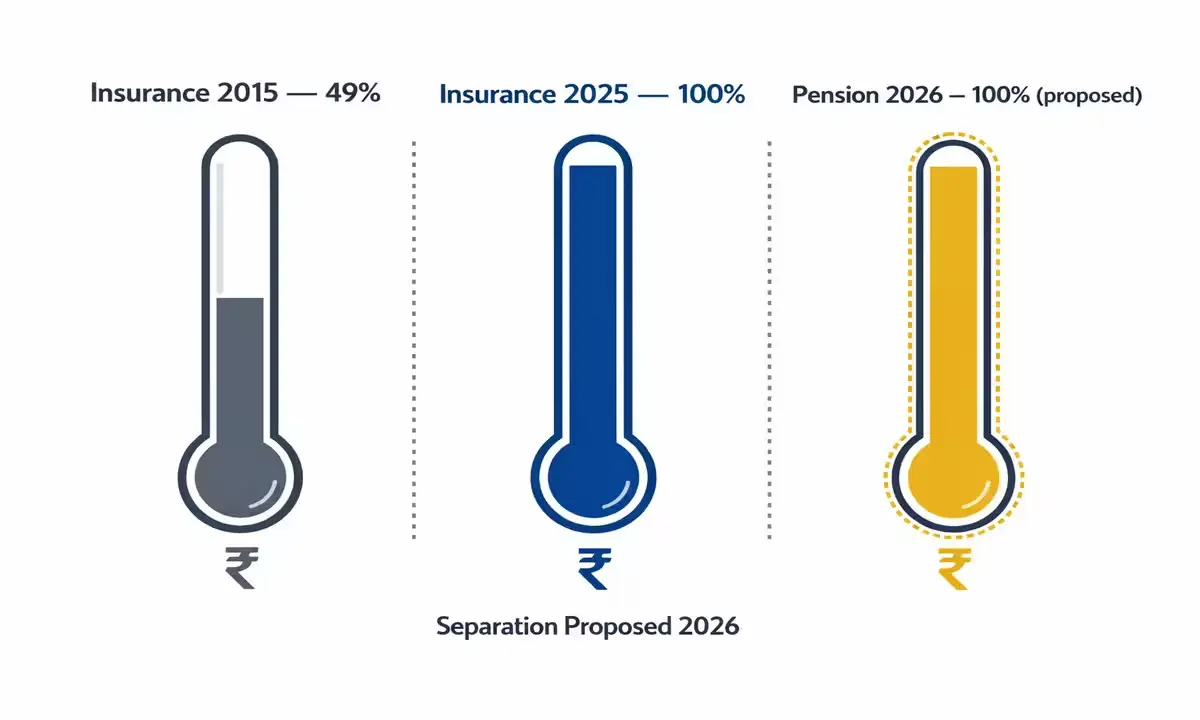
Current FDI in pension funds is capped at 49%. The proposed change aligns the pension sector with the insurance sector, where up to 100% FDI is now permitted. This means foreign entities — global asset managers, sovereign wealth funds, overseas insurers — can acquire majority or full control in Indian pension fund management companies. Your pension fund manager could effectively become a foreign-majority-owned entity.
NPS Trust Is Separated from PFRDA – Legally
The same amendment Bill is expected to include a provision for separating NPS Trust from PFRDA. The powers, functions, and duties of the NPS Trust — currently defined under the PFRDA (National Pension System Trust) Regulations, 2015 – may be transferred to either a charitable trust or placed under the Companies Act. This is a critical structural shift: NPS Trust will no longer be a regulatory creature of PFRDA, but an independent legal entity.
A New 15-Member Board Takes Over Governance of ₹16.5 Lakh Crore
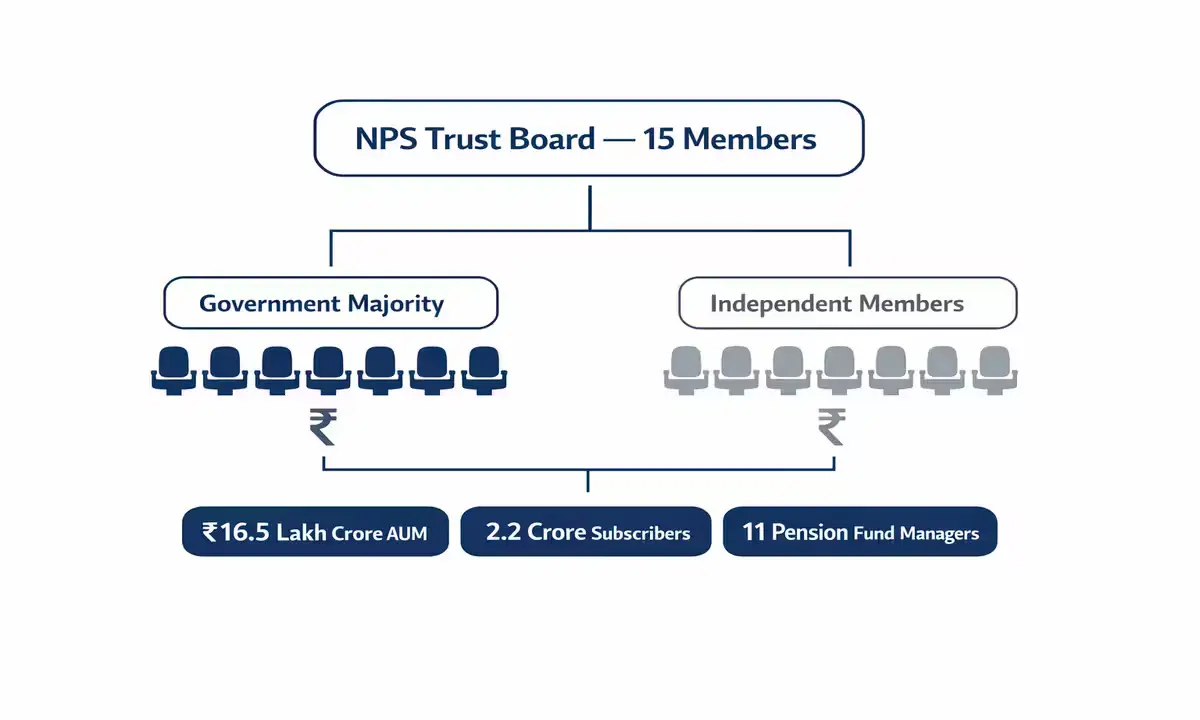
The intent is to keep NPS Trust separate from the pension regulator, managed by a competent board of 15 members, with a majority from the government — since Central and State Governments are the biggest contributors to the corpus. NPS Trust is the registered owner of all assets under the NPS architecture, held for the benefit of subscribers. Securities are purchased by Pension Funds in the Trust’s name, while individual subscribers remain the beneficial owners.
Your Corpus Stays Protected – But Read the Fine Print
Beneficial ownership of your NPS corpus does not change. You remain the beneficial owner of the units in your account. What changes is the legal entity responsible for trust oversight, audit, and subscriber protection monitoring. Until the new Trust board is constituted and transition rules are notified, track updates at npstrust.org.in and
pfrda.org.in.
Source: PTI via Asia Insurance Post, PFRDA portal, verified April 20, 2026.
Why India Is Moving to 100% Pension FDI Now – The Macro Logic Behind a Non-Negotiable 2026 Decision
This is not a random policy announcement. It sits inside a deliberate sequencing of financial sector FDI liberalisation unfolding since 2015 – reaching its logical endpoint in 2026.
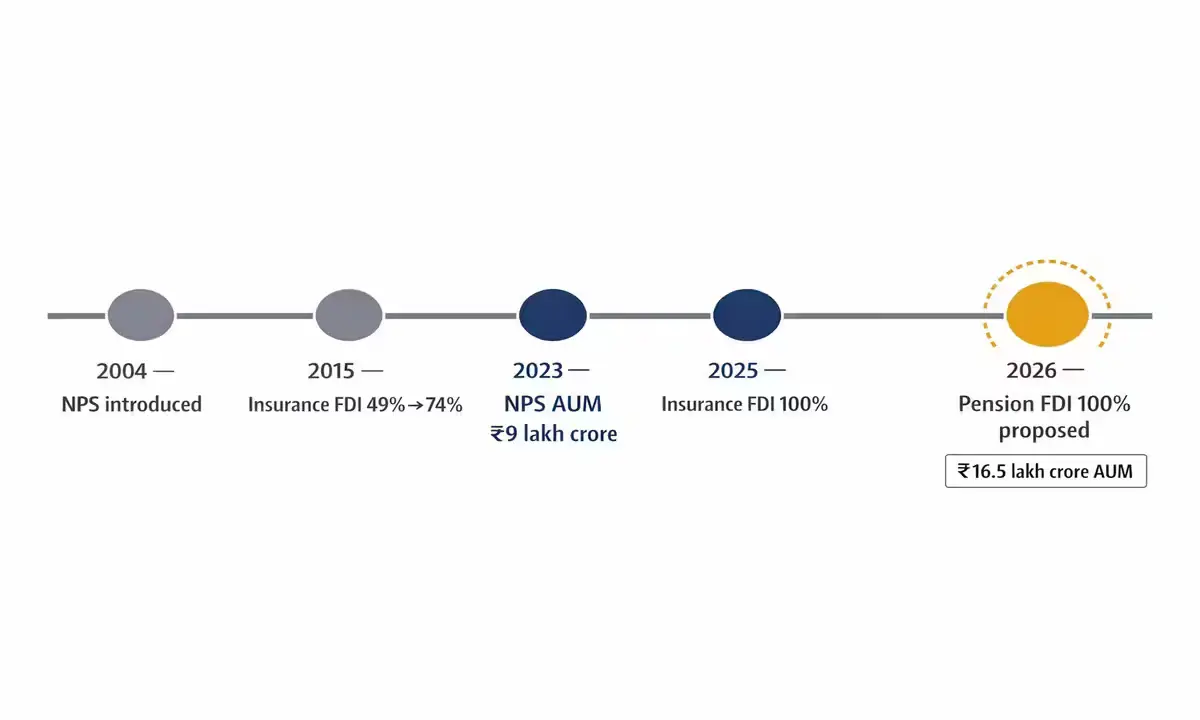
India’s government shifted from a defined benefit (pay-as-you-go) pension system to a defined contribution system (NPS) in 2004 because the old pension bill was becoming fiscally unsustainable. The transition aimed to free limited government resources for more productive socio-economic development. That reform created a professionally managed corpus — now grown to over ₹16.5 lakh crore in AUM as of February 2026, with approximately 2.2 crore subscribers.
Cause: The pension corpus is large enough to attract serious global capital. Foreign pension managers – from Canada’s CPP, Norway’s Government Pension Fund, and Singapore’s GIC – have signalled interest in India’s long-duration retirement market. A 49% FDI cap structurally blocks majority ownership and operational control, a non-starter for large global institutional investors who require board control to deploy capital at scale.
Effect: Removing the FDI ceiling to 100% opens the door for foreign pension fund managers to acquire full operational control of Indian pension fund management companies. This intensifies competition among the current 11 Pension Fund Managers (HDFC, ICICI Prudential, LIC, SBI, UTI, Kotak, Aditya Birla, and others), potentially compressing fund management fees and improving long-term performance benchmarking.
Reader Impact: Since January 1, 2026, Scheduled Commercial Banks have been permitted to sponsor and manage NPS – a move the PFRDA board cleared to strengthen the pension ecosystem and enhance competition. The 100% FDI move is the next step in the same direction. For 2.2 crore existing subscribers, this means more competitive fund management. For the unorganised sector subscriber yet to open an NPS account, it means a richer, better-resourced pension architecture to join.
Source: PTI via Asia Insurance Post (April 19, 2026); PFRDA portal ( April 2026); Wikipedia-PFRDA AUM data (February 2026).
NPS in April 2026: What Has Already Changed and What You Should Do This Week
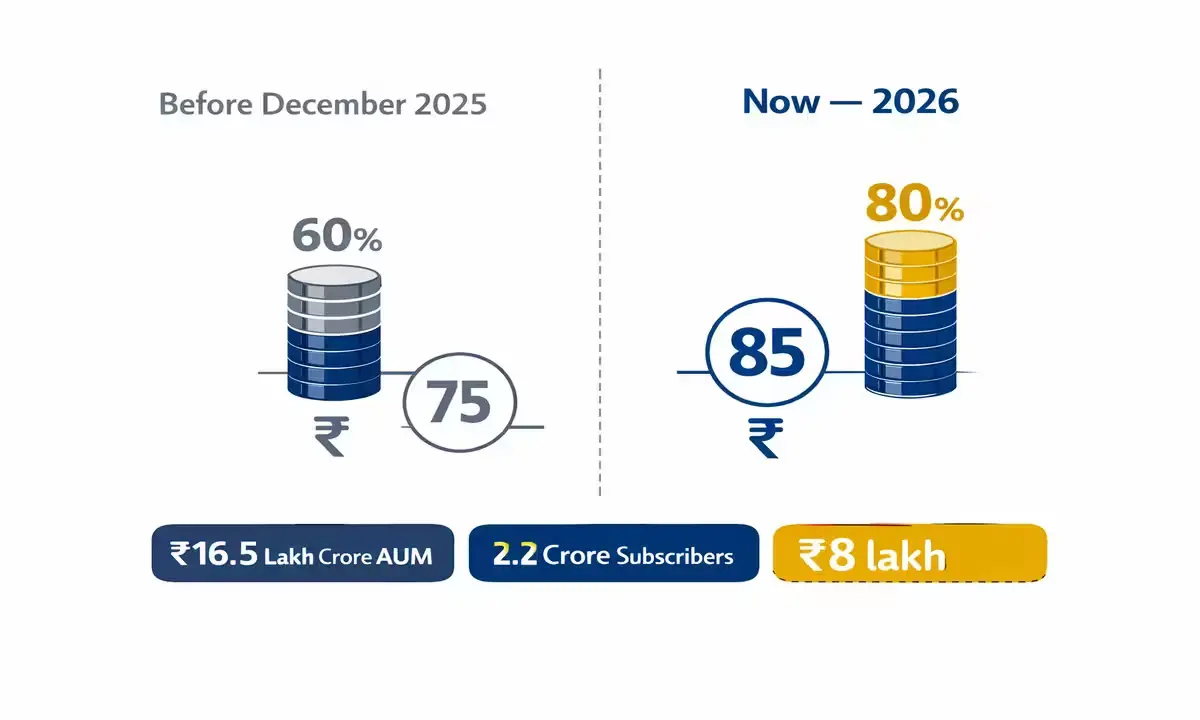
While the FDI amendment is still a Bill in waiting, several mission-critical NPS changes are already live as of April 20, 2026.
| Rule | Before Dec 2025 | Now (Effective 2026) |
|---|---|---|
| Lump sum at exit (non-govt) | 60% lump sum | 80% lump sum ✅ |
| Maximum age in NPS | 75 years | 85 years ✅ |
| Full withdrawal threshold | Corpus ≤ ₹5 lakh | Corpus ≤ ₹8 lakh ✅ |
| Partial withdrawals | 3 times per 4 years | 4 times per 4 years ✅ |
| Banks managing NPS | Not permitted | SCBs permitted from Jan 1, 2026 ✅ |
| Pension FDI limit | 49% | Still 49% – Bill Pending ⏳ |
| NPS Trust governance | Under PFRDA Regulations 2015 | Separation Pending – Bill Needed ⏳ |
eNPS — enps.nsdl.com
this week and verify your nominee details, corpus allocation, and fund manager choice. Given the structural changes coming to NPS Trust governance, confirming your account details before any system transitions is non-negotiable.
Geo-relevance (India – Bihar): For Central Government employees in states including Bihar – where government employment is a dominant segment of the NPS subscriber base — the mandatory contribution structure under NPS Tier-I remains unchanged. The FDI change and Trust separation do not alter the government’s contribution obligations or the subscriber’s existing corpus.
Verified at pfrda.org.in and npstrust.org.in, April 20, 2026.
NPS FDI & Trust Separation 2026
What is the current FDI limit in India’s pension sector and when will it change?
The FDI limit in India’s pension sector is currently 49%, and the government plans to raise it to 100% through an amendment to the PFRDA Act, 2013 — with the Bill likely in the Monsoon Session or Winter Session of Parliament 2026, subject to various approvals. The proposed change mirrors what happened in the insurance sector, where FDI was raised from 74% to 100% by Parliament in 2025. The pension sector is making the jump directly from 49% to 100% — skipping the intermediate stage. This means foreign pension fund managers could soon hold full majority stakes in Indian pension fund management companies.
Source: PTI via Asia Insurance Post, verified April 19, 2026.
What is NPS Trust separation from PFRDA and why does it matter?
The proposed amendment Bill may include a separation of NPS Trust from PFRDA. The powers, functions, and duties of NPS Trust — currently defined under the PFRDA (National Pension System Trust) Regulations, 2015 – may be moved to a charitable trust or placed under the Companies Act, with a new 15-member board, with a majority from the government. NPS Trust is currently the registered owner of all NPS assets – ₹16.5 lakh crore – held for the benefit of 2.2 crore subscribers. Its current responsibility includes monitoring pension funds, custodians, the Central Recordkeeping Agency, Points of Presence, and annuity service providers. Under separation, this oversight role continues – but outside PFRDA’s direct regulatory umbrella.
Source: PTI , PFRDA portal (Tier-1), verified April 20, 2026.
How do the new 2026 NPS withdrawal rules affect my retirement corpus?
The December 2025 PFRDA amendments — already in effect — fundamentally changed what you can do with your NPS corpus at retirement. Non-government subscribers can now withdraw up to 80% of the corpus as a lump sum at normal exit (earlier 60%), with only 20% required for annuity purchase. Subscribers can now stay invested until age 85 and make up to 4 partial withdrawals per 4-year period. If your total NPS corpus at retirement is ₹8 lakh or less, you can withdraw 100% as a lump sum – the previous threshold was ₹5 lakh. For government sector subscribers, the 60:40 lump sum-annuity split broadly remains, but corpus-based slabs also apply there.
Source: PFRDA, verified March–April 2026.
Fast-Track Summary — NPS FDI & Trust Separation 2026
- ✅ Current pension FDI cap: 49% — hard limit under PFRDA Act, 2013
- ✅ Proposed new limit: 100% — matching insurance sector (Parliament-approved 2025)
- ✅ Bill timeline: Monsoon or Winter Session 2026 — unconfirmed, subject to Cabinet approval
- ✅ Second change in the Bill: NPS Trust separation from PFRDA; new 15-member board, majority govt-appointed
- ✅ NPS AUM at stake: ₹16,50,000 crore (₹16.5 lakh crore) — as of February 2026
- ✅ Total subscribers: ~2.2 crore — Central + State govt + private sector + voluntary citizens
- ✅ Already live (Dec 2025 PFRDA amendment): 80% lump sum at exit | age limit 85 | ₹8 lakh full withdrawal | 4 partial withdrawals per 4 yrs
- ✅ Cost / Fee: Free to open online at eNPS | IMF revised from April 1, 2026 (PFRDA circular)
- ✅ Official portals:
pfrda.org.in |
npstrust.org.in |
enps.nsdl.com - ⚠️ Critical Warning: 80% lump sum is PFRDA-permitted but only 60% is tax-free under current IT law. Extra 20% may be taxed until IT rules align.
- ➡️ Your action: Log into enps.nsdl.com this week — verify nominee, corpus split, fund manager. Track amendment progress at pfrda.org.in.
- 📖 Deeper reading: Full NPS policy breakdown — NPS FDI pension policy 2026
Finance Writer — newshours18
Pravin tracks FDI policy changes and pension sector regulation across Indian financial markets, cross-referencing PFRDA, PIB, and Ministry of Finance notifications to report what actually changes for subscribers — not just what the headlines say.