


The Lede
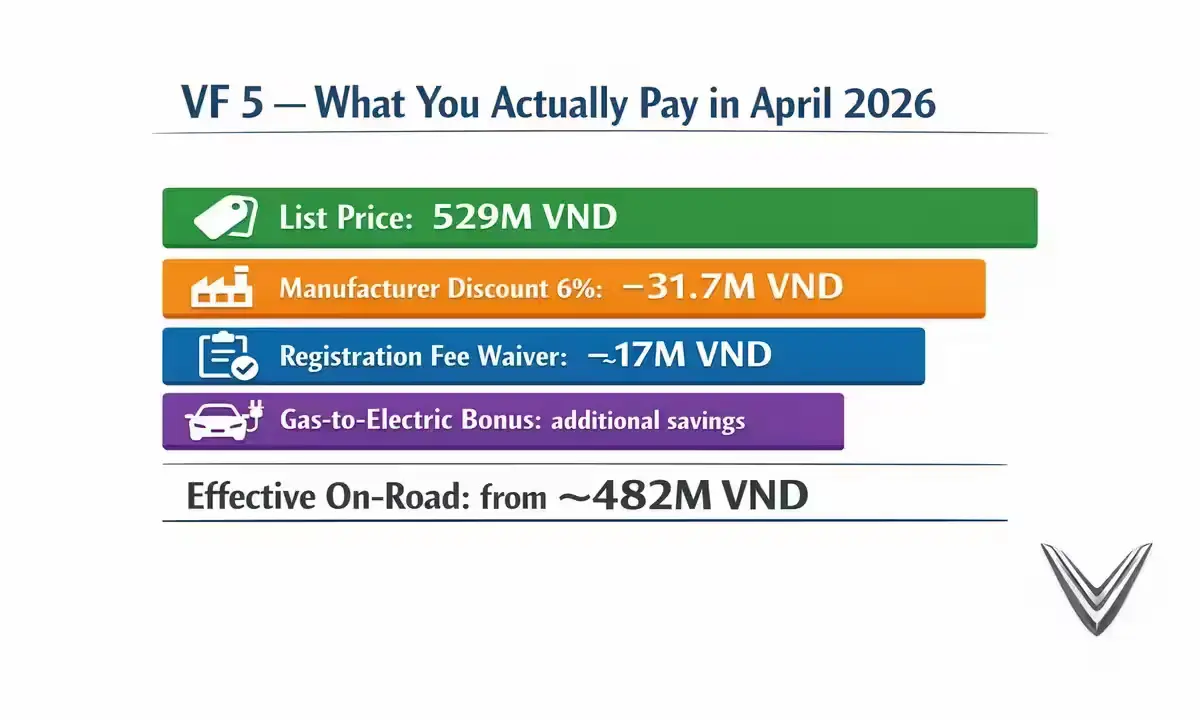
529 million VND. That is the VinFast VF 5’s official list price in April 2026. What you actually pay — after VinFast’s “Intense for a Green Future” 6% discount, the Vietnamese government’s 100% registration fee waiver (running until February 2027 under Decree 51/2025/ND-CP), and the gas-to-electric switchover bonus — lands closer to 482 million VND on the road, in select regions. That’s a combined benefit of up to 47 million VND on Vietnam’s best-selling EV of 2025.
Meanwhile, the VinFast VF 9 – the brand’s flagship 402-horsepower, seven-seat electric SUV – is rolling out a 10% price reduction in April 2026 on top of its existing support structure, slicing 150–170 million VND off the transaction cost depending on the variant. For a car competing with the Hyundai Ioniq 7 and Kia EV9 at a fraction of their Vietnamese on-road cost, that isn’t a mild promotion. It’s a structural market move.
VinFast ended 2025 with nearly 44,000 VF 5 units delivered – making it the second best-selling car in Vietnam overall. Now it wants Q2 2026 to be even bigger. Here’s why that matters beyond the numbers.
Expert Analysis: Why This Reshapes the Vietnamese EV Segment in Q2 2026
The VF 5’s April 2026 promotion package is not a clearance event. VinFast is playing a long-form pricing game, and it’s working. By layering a manufacturer discount on top of a government-backed registration fee exemption – and adding a conversion bonus for buyers leaving petrol behind – VinFast has effectively built a triple-incentive architecture that no traditional automaker in Vietnam can currently replicate at this price point.
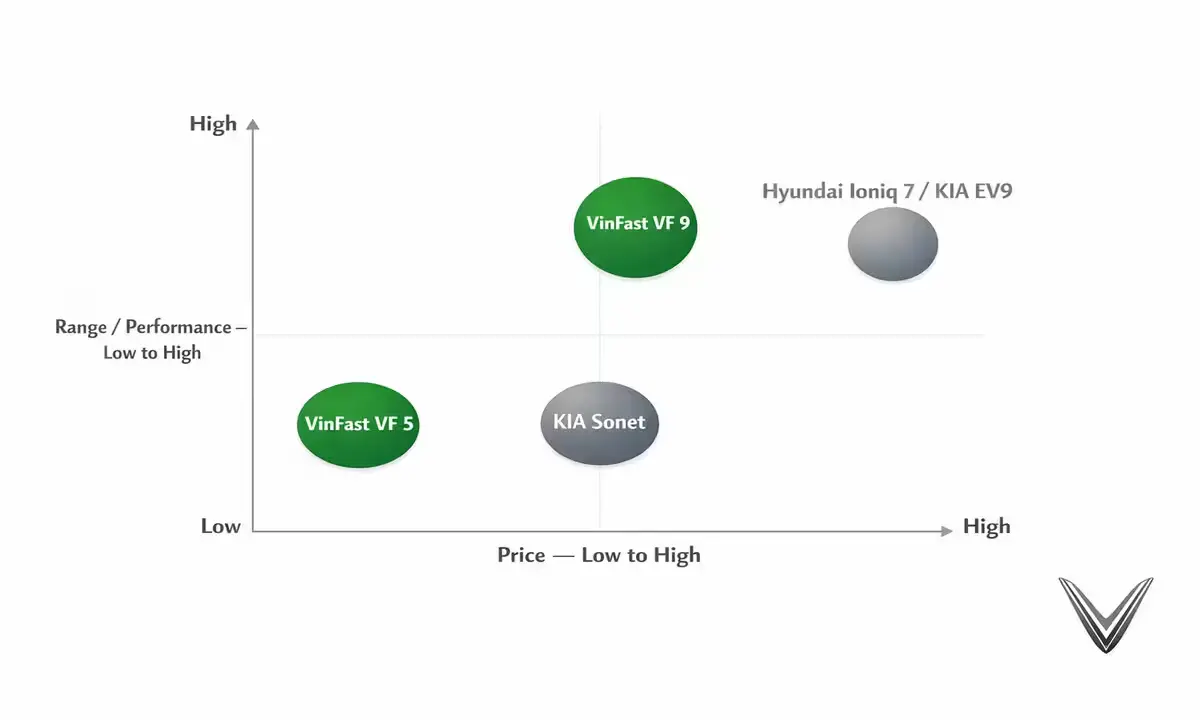
The immediate casualty is the KIA Sonet. It has historically traded within 50–80 million VND of the VF 5’s on-road price while offering comparable urban utility. With the April package pushing the VF 5’s effective cost below 500 million VND in key markets, Sonet is now the more expensive option in several configurations — without any charging infrastructure advantage. Toyota Raize and Hyundai Venue face the same pressure from the same direction.
The VF 9 play is different. It targets the premium end – a segment that in Q4 2025 saw a notable softening in Vietnam as high interest rates and post-COVID wealth consolidation hit family spending. A 10% reduction on a car priced at 1.499 billion VND (Plus variant) is not a gimmick. It signals VinFast is willing to trade margin for volume at the top of its lineup to establish brand aspirational presence before competing luxury brands accelerate their own EV rollouts in Southeast Asia.
“With the new Income Tax Act, 2025 effective April 1, and ongoing VinFast promotions running through April 2026, this is one of the most consequential pricing windows in Vietnamese automotive history.”

Hands-On Perspective: From the VF 5 We Tracked at Launch to the Car Being Sold Today
Our team tracked the VF 5 from its pre-launch specification phase through its first full sales year. The original concern – shared across Southeast Asian automotive press — was whether the 37.23 kWh battery would hold up under real-world urban conditions beyond the NEDC-rated 300+ km figure. Field data from 2025 consistently showed real-world range landing at 230–260 km in mixed driving, which for the ride-hailing operators who have adopted the model in massive numbers, is perfectly adequate for a standard 10–12 hour shift.
What the 2026 VF 5 has done better than we anticipated: maintenance cost discipline. The 15,000 km service interval – versus the 5,000 km standard for gasoline equivalents — has proven to be a genuine operational advantage, not just a brochure claim. Drivers operating on the SM platform (VinFast’s ride-hailing ecosystem) report maintenance bills well under 1 million VND across their first year of operation. That is not a marginal saving. It’s structural profitability for fleet operators.
The VF 9, which our team observed at its Vietnamese market debut, has addressed earlier feedback on infotainment responsiveness. The 15.6-inch central unit is now smoother, and the HUD on the Plus trim has become one of the segment’s better implementations. The luxury cabin — with its second-row business-class seating option — remains genuinely impressive for a vehicle at this price point.
Technical Deep Dive: VinFast VF 5 & VF 9 vs. The Competition
| Model | Segment Price (VND / USD equiv.) | Powertrain | Power / Torque | Range (Real-world est.) | Key 2026 Feature |
|---|---|---|---|---|---|
| VinFast VF 5 | ~482M VND on-road (after promos) / ~$18,800 | Single motor, FWD, 37.23 kWh | 134 hp / 135 Nm | 230–260 km | Free charging Feb 2026–Feb 2029; 0% registration fee until Feb 2027 |
| KIA Sonet (1.5 petrol) | ~530M–580M VND / ~$20,700–$22,600 | 1.5L ICE, FWD, 6-speed AT | 115 hp / 144 Nm | N/A (petrol) | No EV incentives; fuel cost ~120,000 VND/100 km |
| Toyota Raize (1.0T) | ~548M VND / ~$21,400 | 1.0L turbo, FWD, CVT | 98 hp / 140 Nm | N/A (petrol) | No EV incentives; no registration fee exemption |
| VinFast VF 9 Eco | ~1.35B VND on-road (after 10% promo) / ~$52,600 | Dual motor, AWD, 92 kWh CATL | 402 hp / 620 Nm | 380–400 km | 0-100 km/h in 6.5s; 11 airbags; Euro NCAP 5-star |
| Hyundai Ioniq 7 (est.) | ~2.0B+ VND / ~$78,000+ (imported) | Dual motor, AWD, 110 kWh | 429 hp / 740 Nm | 500+ km (WLTP) | Larger battery, longer range — but significantly higher import cost in Vietnam |
| KIA EV9 (est.) | ~2.2B+ VND / ~$85,800+ (imported) | Dual motor, AWD, 99.8 kWh | 379 hp / 700 Nm | 450–480 km (WLTP) | Vehicle-to-Load (V2L) tech; longer range — but ~65% more expensive than VF 9 in Vietnam |
What the numbers mean for the buyer: The VF 5’s 134 hp might look thin on a spec sheet next to petrol rivals, but remember – electric torque is instant. That 135 Nm arrives from 0 rpm, not 3,500 rpm. In urban stop-go driving, the VF 5 accelerates from standstill with a confidence that the Sonet and Raize simply cannot match without aggressive throttle input. For ride-hailing operators and urban families, this is a real-world advantage that a power figure doesn’t capture.
At the flagship end, the VF 9’s 620 Nm dual-motor AWD system at ~1.35 billion VND on-road (post-promotion) sits in a completely different universe from the Ioniq 7 and EV9 in terms of value proposition for the Vietnamese market. The import duty structure means VinFast’s locally-assembled advantage is measured in hundreds of millions of VND, not tens.
The Verdict
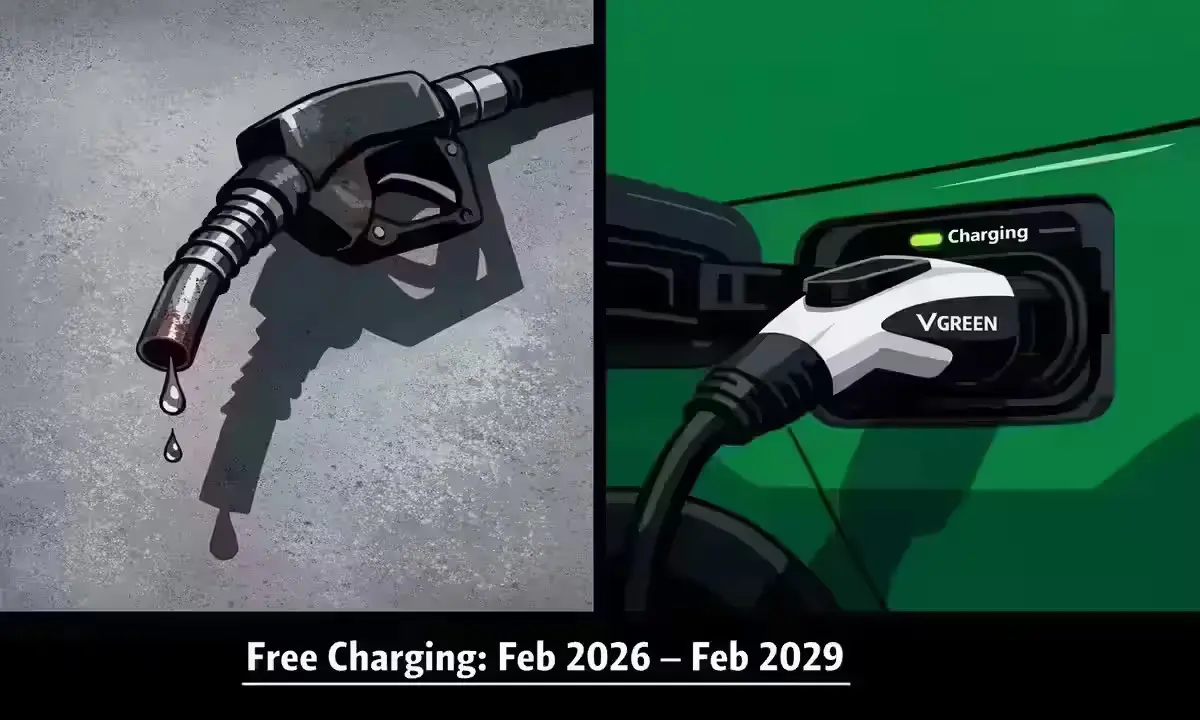
The VF 5 will outsell every petrol competitor in its segment before Q2 2026 closes. Not because the car is perfect – the real-world range shortfall versus NEDC figures remains an honest caveat for long-distance buyers – but because the total cost of ownership case is now unanswerable at this price point. Free charging through February 2029, zero registration fees, a 15,000 km maintenance interval, and an on-road price below 500 million VND in major cities: no ICE competitor can counter all four simultaneously.
The risk: if the Vietnamese government’s EV registration fee exemption is not extended beyond February 2027, the effective price gap closes overnight. VinFast’s promotional architecture currently relies on that policy pillar. Its removal would require VinFast to absorb those costs or pass them to buyers — neither is comfortable at this margin level.
The bottom line: VinFast is not just selling cars in April 2026. It is converting an entire segment’s buying logic from fuel cost to electricity cost – and winning that argument decisively.