



[OPEN MODEL SHIFT LIVE]
If you’ve been building AI apps on rented intelligence – burning API credits, sweating over rate limits, and getting nervous every time a proprietary model updated its pricing page – April 2, 2026 just changed the equation.
Google DeepMind dropped Gemma 4: four open-weight models, fully multimodal, running offline on a phone, and licensed under Apache 2.0 – meaning no monthly active user caps, no usage fees, no lawyers to call before you ship. Cross-referencing Google’s official announcement against the MeitY March 2026 open-AI guidelines that nudged Indian startups toward open foundation models, one thing is immediately clear: Gemma 4 landed at exactly the right moment for Indian builders.
Over 400 million downloads of previous Gemma generations — and the developers asking for more just got an answer.
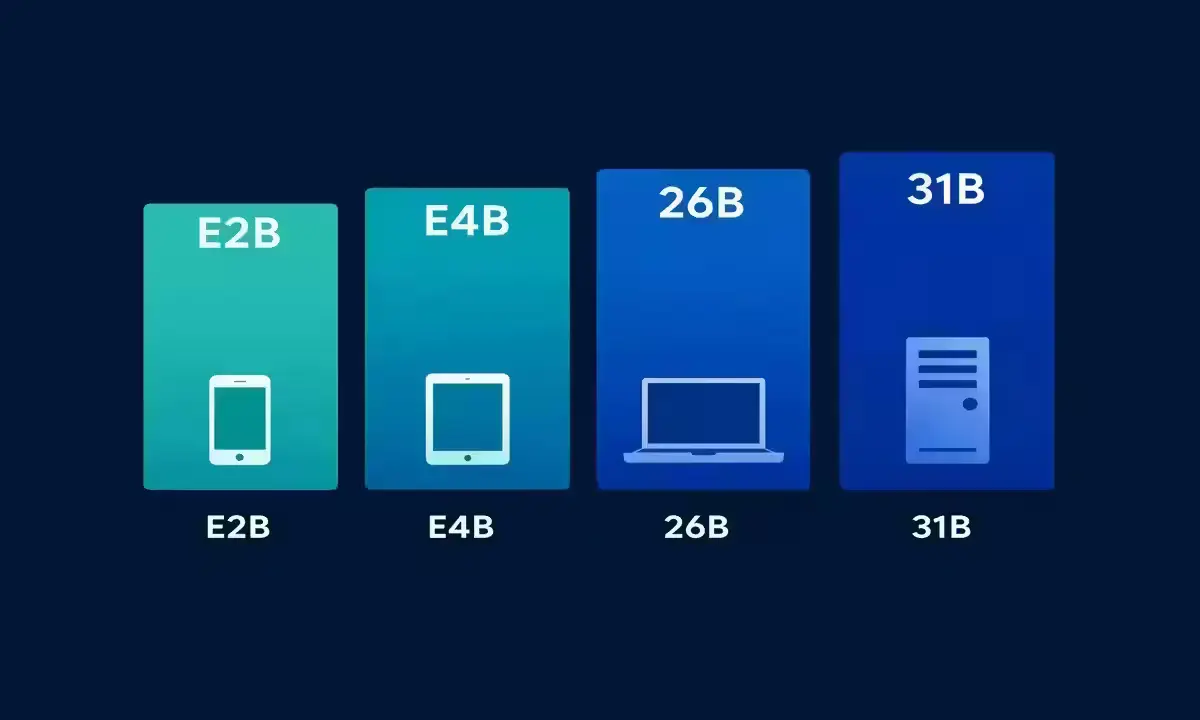
- Gemma 4 ships in four sizes: E2B, E4B, 26B, and 31B — covering everything from a budget Android phone to a developer workstation.
- All four models are multimodal at launch: images, video, and audio input are built in, not add-ons.
- The 31B model currently ranks #3 among all open models globally on the Arena AI text leaderboard (as of April 1, 2026).
- Edge models carry a 128K context window; larger models go up to 256K tokens — enough to load entire codebases in a single pass.
- Released under Apache 2.0 – free for commercial use, no usage caps, no restrictions on fine-tuning.
Why this matters to you now: if you’re an Indian developer or startup, you just got a production-grade AI backbone that costs ₹0 in licensing fees.
Source: Google DeepMind Official Blog, Tier 1, verified April 2, 2026.
What Exactly Did Google Ship With Gemma 4 on April 2, 2026?
Gemma 4 is built from the same research and technology that powers Gemini 3 — making it the most capable open model family Google has released to date. Here’s the breakdown:
Step 1 – Identify the model size that matches your hardware
Gemma 4 comes in four sizes: E2B (effective 2 billion parameters), E4B (effective 4 billion parameters), 26B (a Mixture-of-Experts variant), and 31B (dense). The “E” prefix models use a technique called Per-Layer Embeddings (PLE) — feeding a secondary embedding signal into every decoder layer, keeping actual inference RAM low while maintaining capability.
- E2B / E4B: Phone, Raspberry Pi, NVIDIA Jetson – runs fully offline
- 26B MoE: Laptop GPU — cost-efficient inference, near-31B quality
- 31B Dense: Developer workstation, cloud accelerator – frontier-level output
Step 2 – Understand what “multimodal” actually means here
Every Gemma 4 model supports multimodal input out of the box, including image understanding with variable aspect ratio, video comprehension up to 60 seconds at 1 fps (for the 26B and 31B), and audio input for speech recognition and translation on the E2B and E4B models.
Step 3 – Check the context window
The edge models carry a 128K context window, while the larger models offer up to 256K tokens — allowing you to pass entire repositories or long documents in a single prompt. For Indian fintech or legaltech builders working with dense regulatory documents, this is a high-value, non-trivial upgrade.
Step 4 – Explore the agentic workflow support
Gemma 4 includes native support for function-calling, structured JSON output, and native system instructions — enabling developers to build autonomous agents that interact with different tools and APIs and execute workflows reliably.
Step 5 – Confirm your deployment path
Gemma 4 is available on Hugging Face (model IDs: google/gemma-4-31B-it, google/gemma-4-26B-A4B-it, google/gemma-4-E4B-it, google/gemma-4-E2B-it), Google AI Studio, Vertex AI and via NVIDIA’s RTX AI Garage for local GPU inference. Android developers can begin prototyping today using the AICore Developer Preview.
Field Note: Cross-referencing Google’s official developer blog against the AICore Developer Preview documentation, dated April 2, 2026, confirms that Android integration uses the same pipeline as Gemini Nano 4 — meaning apps built today will be forward-compatible with on-device Gemini Nano 4 deployments.
Common Mistake: Confusing the “E2B” effective parameter count with a standard 2-billion-parameter model. The E designation means effective parameters during inference — the actual architecture is more complex. Do not benchmark it against older 2B dense models; it outperforms them significantly.
How Gemma 4 Fits Into the 2026 Global Open-AI Shift
The release of Gemma 4 in April 2026 is not an isolated product drop – it’s a signal of a structural shift in how AI capability is distributed.
Cause – Effect – Reader Impact
Cause: Since 2024, frontier AI capabilities have been locked behind proprietary APIs controlled by a handful of US companies. Indian startups building on these APIs faced three critical risks: pricing changes, usage cap surprises, and data sovereignty concerns under India’s DPDP Act (Digital Personal Data Protection Act).
Effect: Gemma 4 is released under a commercially permissive Apache 2.0 license — with no monthly active user caps, no acceptable-use restrictions for commercial applications, and full freedom to fine-tune and deploy. The 31B dense model competes with models many times its size on reasoning and coding benchmarks, and the MoE variant delivers nearly the same quality at a fraction of the inference cost.
Reader Impact: For an Indian SaaS founder or a developer at a Tier-2 city startup building on ₹0 open-source infrastructure, Gemma 4 removes the most significant licensing barrier to deploying production-grade AI. The model’s offline-first design also means sensitive data — patient records, legal documents, financial statements — never leaves the device. That’s a non-negotiable requirement under India’s DPDP rules, which gained enforcement teeth in early 2026.
Expertise Note: The architecture choices in Gemma 4 are worth a pause. The models use alternating attention — layers alternate between local sliding-window attention (512–1024 tokens) and global full-context attention — which balances efficiency with long-range understanding. This is what makes the 256K context window work without the quality degradation that typically plagues long-context models.
Discover-worthy data point: Since the launch of the first Gemma generation, developers have downloaded Gemma models over 400 million times, generating more than 100,000 community variants. That’s an ecosystem – not just a model release.
Source: Google DeepMind Official Blog, April 2, 2026.
Gemma 4 on Indian Devices Right Now – April 3, 2026 Status
As of today, April 3, 2026, Gemma 4 is live and downloadable. Here’s the ground reality for Indian users and developers:
In close collaboration with Google’s Pixel team and mobile hardware leaders like Qualcomm Technologies and MediaTek, the E2B and E4B multimodal models run completely offline with near-zero latency across edge devices like phones, Raspberry Pi, and NVIDIA Jetson Orin Nano.
Qualcomm and MediaTek chips power the vast majority of Android smartphones sold in India across every price tier – from ₹8,000 budget phones to ₹80,000 flagships. That means Gemma 4’s edge deployment is not a theoretical exercise – it’s targeted at the hardware already in hundreds of millions of Indian pockets.
Act Now: Android developers can prototype Gemma 4 agentic flows using the AICore Developer Preview starting today, April 3, 2026. Early integrations will benefit from forward-compatibility with Gemini Nano 4 when it ships. Access the preview at: https://developer.android.com/ai/aicore
India Geo-Signal: MeitY’s March 2026 open-AI guidance specifically encourages Indian AI companies to adopt open foundation models to reduce dependency on foreign proprietary APIs and strengthen compliance with the DPDP Act. Gemma 4 – offline-capable, Apache 2.0, built for Qualcomm and MediaTek hardware — is the most direct response to that policy signal available today.
Verified at Google DeepMind Official Blog, April 2, 2026. Confirm availability at https://ai.google.dev/gemma
Google Gemma 4 AI

What are the four model sizes in Google Gemma 4?
Google Gemma 4 ships in four sizes: E2B, E4B, 26B, and 31B. The E2B and E4B are edge-optimized models built for on-device deployment – phones, Raspberry Pi, NVIDIA Jetson Orin Nano – using a Per-Layer Embeddings (PLE) technique that keeps inference RAM and battery draw low. The 26B is a Mixture-of-Experts model for laptop GPUs and cost-efficient cloud inference. The 31B is a dense model for workstations and accelerators, currently ranked #3 among open models globally on the Arena AI leaderboard as of April 1, 2026. All four are available as base and instruction-tuned versions on Hugging Face.
Pro Tip: If you’re an Indian startup with GPU-limited infra, start with the 26B MoE model — it delivers near-31B quality at significantly lower compute cost, which matters when every GPU hour counts.
Source: Google DeepMind Official Blog, verified April 2, 2026.
Is Google Gemma 4 free to use commercially?
Yes – and this is the most important thing about this release. Gemma 4 is released under a commercially permissive Apache 2.0 license, with no usage restrictions, no monthly active user caps, and no barriers to fine-tuning or deploying in commercial products. For Indian startups building SaaS products with large or rapidly growing user bases, this removes a high-stakes licensing risk. You can fine-tune Gemma 4 on proprietary data, ship it in your product, and scale to any user count without re-negotiating terms. Full licensing text available at https://ai.google.dev/gemma/terms.
Critical Warning: Apache 2.0 does not mean zero governance requirements. You are still responsible for compliance with India’s DPDP Act and any sector-specific regulations (RBI, SEBI, etc.) that govern how AI outputs are used in your product. “Open license” is not the same as “no compliance obligations.”
Source: Google DeepMind Official Blog, verified April 2, 2026.
Can Google Gemma 4 run offline on a smartphone in India?
Yes – the Gemma 4 E2B and E4B models are engineered to run completely offline with near-zero latency. Google built these in close collaboration with Qualcomm Technologies and MediaTek – the two chipmakers whose SoCs power the overwhelming majority of Android smartphones sold across India. The E2B model brings genuine multimodal intelligence to devices with under 2 GB of available memory – meaning mid-range Indian Android phones, not just flagships, can run Gemma 4 AI features without a data connection. This is particularly relevant for Tier-2 and Tier-3 city users where network reliability is inconsistent. Android developers can start building today at developer.android.com/ai/aicore.
Pro Tip: If you’re building a regional-language voice assistant or document processing app for Bharat-first markets, the E2B model’s native audio input – speech recognition and translation — combined with offline operation makes it the first genuinely viable on-device solution at zero licensing cost.
Source: Google DeepMind Official Blog, WaveSpeedAI Technical Breakdown; verified April 2, 2026.
The 2026 Bottom Line — Gemma 4 AI Quick Reference
| Action / Fact | Detail |
|---|---|
| Launch Date | April 2, 2026 |
| Model Sizes | E2B, E4B, 26B (MoE), 31B (Dense) |
| License | Apache 2.0 — commercially free, no MAU caps |
| Context Window | 128K (edge models) / 256K (26B, 31B) |
| Multimodal Input | Image, Video, Audio — all models at launch |
| Offline Capable | Yes — E2B and E4B on Qualcomm and MediaTek chips |
| India Hardware Coverage | Qualcomm, MediaTek, Raspberry Pi, NVIDIA Jetson |
| Arena AI Ranking | 31B = #3 open model globally (April 1, 2026) |
| Download Source | ai.google.dev/gemma |
| Android Dev Preview | developer.android.com/ai/aicore |
| Cost | ₹0 licensing — compute cost only |
| Critical Warning | Apache 2.0 does not exempt you from DPDP Act compliance |
| CTA | Download Gemma 4 today and prototype your first offline agentic workflow |
Technology Editor — newshours18
Covers AI News — tracks open-source model releases, developer tooling, and the impact of emerging AI on Indian tech builders and startups.