

■ RULES RESET: ACT NOW
By Pravin Kumar | Finance Editor | 31 March 2026
Tax
ITR
PAN
Banking
Cross-referencing the CBDT-notified Income Tax Rules, 2026 – released in the official gazette in March 2026 – against the existing Income Tax Rules, 1962, one shift stands out immediately: India just compressed a 511-rule tax code into 333 rules overnight. That’s not a tweak. That’s a structural reset.
And it lands tomorrow – except it’s already today. From 1 April 2026, the rules governing your salary slip, your PAN card, the toll plaza you drive through, and even the ATM you queue at have changed. Not all of them will hurt. Some actually give your wallet breathing room. But the ones that tighten — they’re non-negotiable and effective immediately.
Whether you’re a salaried taxpayer in Patna, a trader running F&O positions in Mumbai, or someone who just wants to renew their FASTag pass without a surprise — here’s exactly what changed and what it means for you in FY 2026-27.
WHAT CHANGED FROM APRIL 1 2026 — 80-SECOND BRIEF
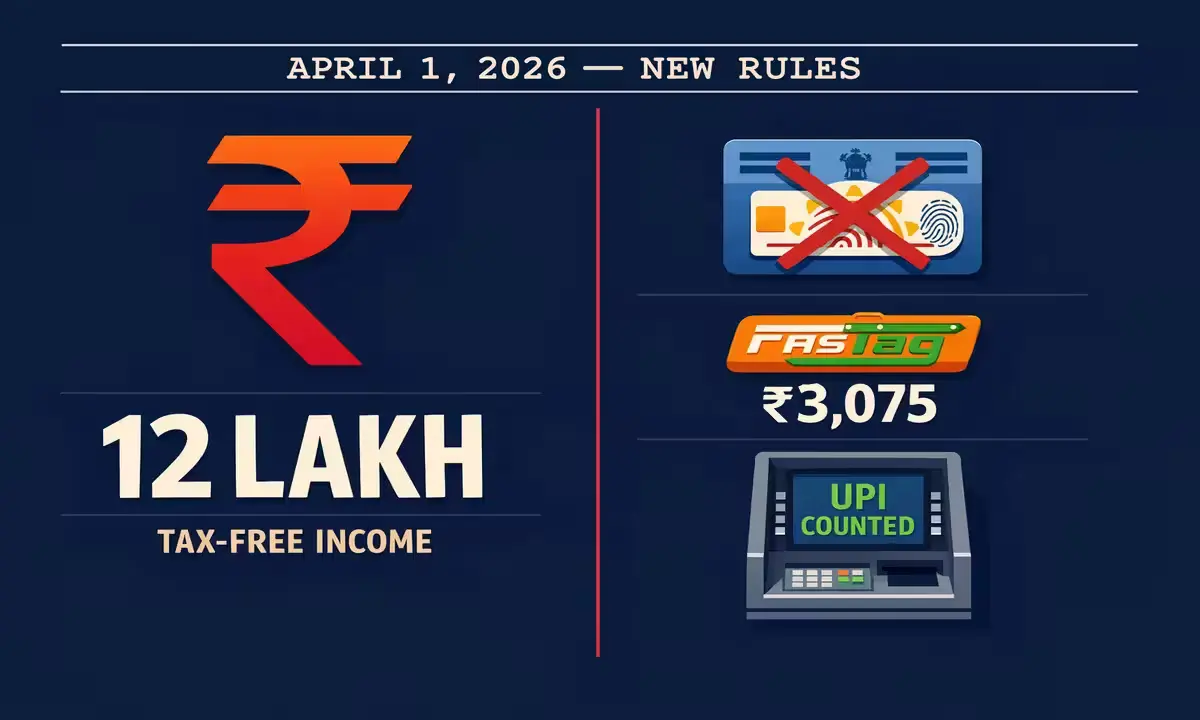
- Zero tax on ₹12 lakh income — Enhanced Section 87A rebate (up to ₹60,000) makes income up to ₹12 lakh effectively tax-free under the new regime from FY 2026-27.
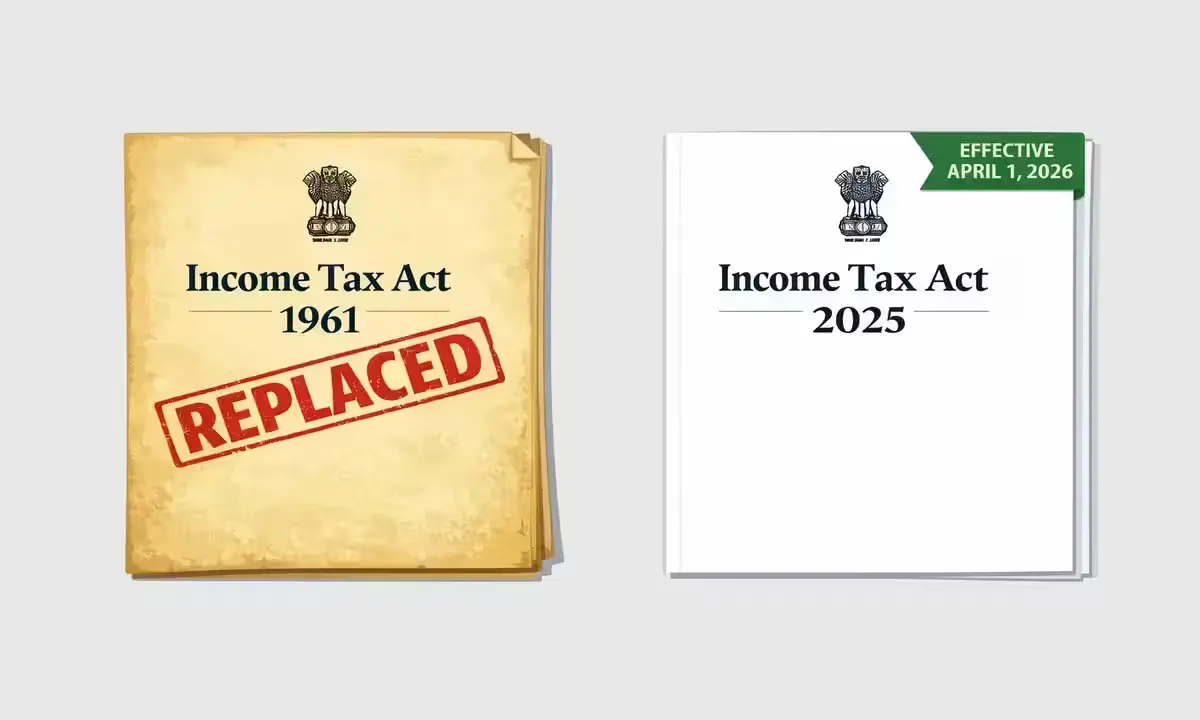
- New Income Tax Act 2025 kicks in — The 64-year-old Income Tax Act, 1961 is replaced. “Financial Year” and “Assessment Year” are gone — replaced by a single term: “Tax Year.”
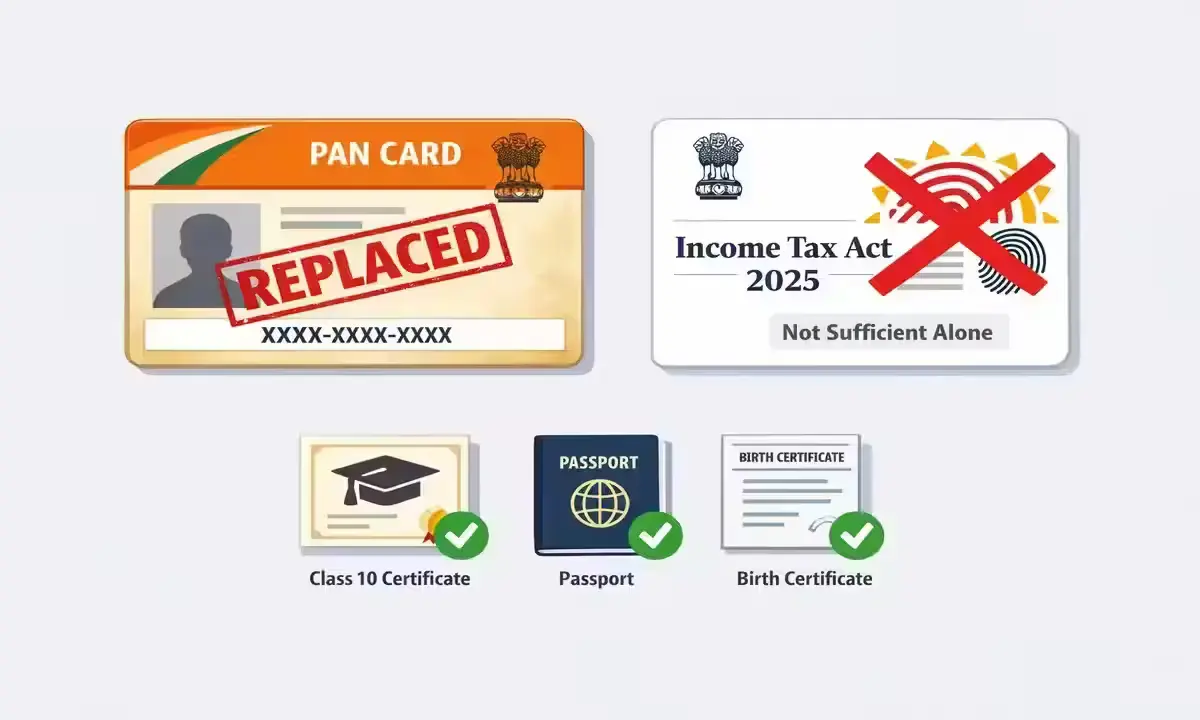
- PAN rules get stricter — Aadhaar alone can no longer be used as date-of-birth proof for a new PAN. You now need a Class 10 certificate, passport, or birth certificate.
- FASTag Annual Pass costs more — Fee rises from ₹3,000 to ₹3,075. Highway cash payments at toll plazas are now banned — only FASTag or UPI accepted.
- ATM charges expand scope — UPI-based cardless ATM withdrawals now count toward your free monthly transaction limit. Breach it and pay ₹23 + taxes per transaction.
Why this matters to you now: These rules are live from April 1, 2026 — there is no grace period.
Source: CBDT (Tier 1), ClearTax (Tier 2), verified 31 March 2026.
How Do These April 1 2026 Rule Changes Actually Affect Your Tax Filing – Step by Step?
Most people read a list of changes and forget them by evening. What you actually need is a sequence — what to do first, what to check, and what mistake trips up even people who’ve been filing ITR for years.
- Confirm which tax regime you’re in for FY 2026-27. Under the new tax regime, income up to ₹12 lakh is tax-free via the enhanced Section 87A rebate of ₹60,000. Under the old regime, the exemption limit remains ₹5 lakh. If your employer hasn’t issued a fresh declaration form yet, follow up now — your TDS deductions for April depend on this choice.
- Note that “Assessment Year” no longer exists for FY 2026-27 onwards. The Income Tax Act, 2025 replaces the dual system of Financial Year and Assessment Year with a single “Tax Year.” Your ITR portal interface will reflect this terminology. Don’t panic if the labels look unfamiliar – the filing process is structurally the same.
- Update your ITR filing deadline awareness. For non-audit taxpayers filing ITR-3 and ITR-4, the deadline has been extended to 31 August (from the earlier 31 July). ITR-1 and ITR-2 deadlines remain at 31 July. Tax audit cases retain their 31 October deadline. Source: CBDT notification, effective from FY 2025-26 (AY 2026-27).
- Prepare for Form 130 to replace Form 16. From April 1 2026, your employer will issue Form 130 (replacing Form 16) and Form 131 (replacing Form 16A) as TDS certificates. The timelines for issuing these forms have also changed. Ensure your HR or payroll team is aware – if you receive an old Form 16 for FY 2026-27, flag it immediately.
- If you’re buying property from an NRI, use the new PAN-based TDS process. From April 1, you no longer need to register for TAN to deduct TDS under Section 194IA. A PAN-based challan is now sufficient. This removes a significant compliance hurdle for home buyers dealing with NRI sellers.
- If you file Form 15G or 15H, consolidate your submissions. Earlier you had to submit these forms to every bank, mutual fund, or financial institution separately. From April 2026, a single submission to your NSDL/CDSL depository is sufficient — details are shared across institutions automatically.
Field Note
After speaking with salaried professionals and HR managers in Patna during March 2026, one thing was clear: the shift from “Assessment Year” to “Tax Year” is creating confusion in corporate payroll systems that haven’t updated their software. If your March payslip still shows AY 2025-26 terminology for April deductions, ask your payroll team to verify they’ve applied the correct FY 2026-27 rates.
Common Mistake
Many taxpayers assume the ₹12 lakh zero-tax threshold means no tax filing is needed. Wrong. If your gross income exceeds ₹12 lakh – even if the rebate brings your liability to zero — you must still file your ITR by the applicable deadline. Skipping the filing attracts a late fee under Section 234F of the new Income Tax Act, 2025.
For a detailed breakdown of the new PAN card rules 2026, see our related guide on PAN documentation changes effective April 1, 2026.
The New Income Tax Act 2025 Is Not Just a Rebrand – Here’s the Real Shift Behind April 1
In March 2026, the Central Board of Direct Taxes (CBDT) formally notified the Income-tax Rules, 2026 in the official gazette, bringing the total rule count down from 511 to 333. That compression is the macro story most coverage misses entirely.
The Income Tax Act, 1961 was built for a pre-digital India. By 2026, India has over 87 million active ITR filers (CBDT data, 2025), a surge in gig economy income, widespread stock market participation, and cross-border digital transactions that the 1961 law was never designed to handle cleanly.
Cause → Effect → Reader Impact:
The cause is structural mismatch: 65 years of amendments and circulars that even tax professionals needed weeks to decode. The effect of the new Income Tax Act, 2025 is simplification with parity — same rates, same slabs, but clearer. The reader impact is real: four new cities — Bengaluru, Pune, Hyderabad, and Ahmedabad — are now included in the 50% HRA exemption category (previously only Delhi, Mumbai, Chennai, and Kolkata). If you’re a salaried employee renting in any of these cities under the old tax regime, your HRA exemption just increased significantly from April 1.
Expertise Note
The four new tech cities added to the 50% HRA bracket represent a long-overdue correction. Bengaluru’s average rent for a 2BHK in 2026 exceeds ₹35,000/month – well above many Tier-1 cities that already held metro status. The 40% cap that applied previously meant HRA claims were under-reported by lakhs annually. This change, sourced from the CBDT-notified Income Tax Rules, 2026, is the single biggest benefit for IT and startup workers in South and West India.
The macro shift also extends to capital markets. Proceeds from share buybacks — previously treated as deemed dividends – will now be taxed as capital gains from April 1. For individual promoters, the effective rate is 30%; for corporate promoters, 22%. Additionally, Securities Transaction Tax (STT) on derivatives has been increased – a mission-critical cost factor for active F&O traders.
Source: Income Tax Act, 2025 ; ClearTax analysis, March 2026
What’s Changing at Toll Plazas, ATMs and Banks Effective 31 March–1 April 2026
As of 31 March 2026 – the last day of FY 2025-26 — here’s what goes live at midnight across India’s banking and highway infrastructure.
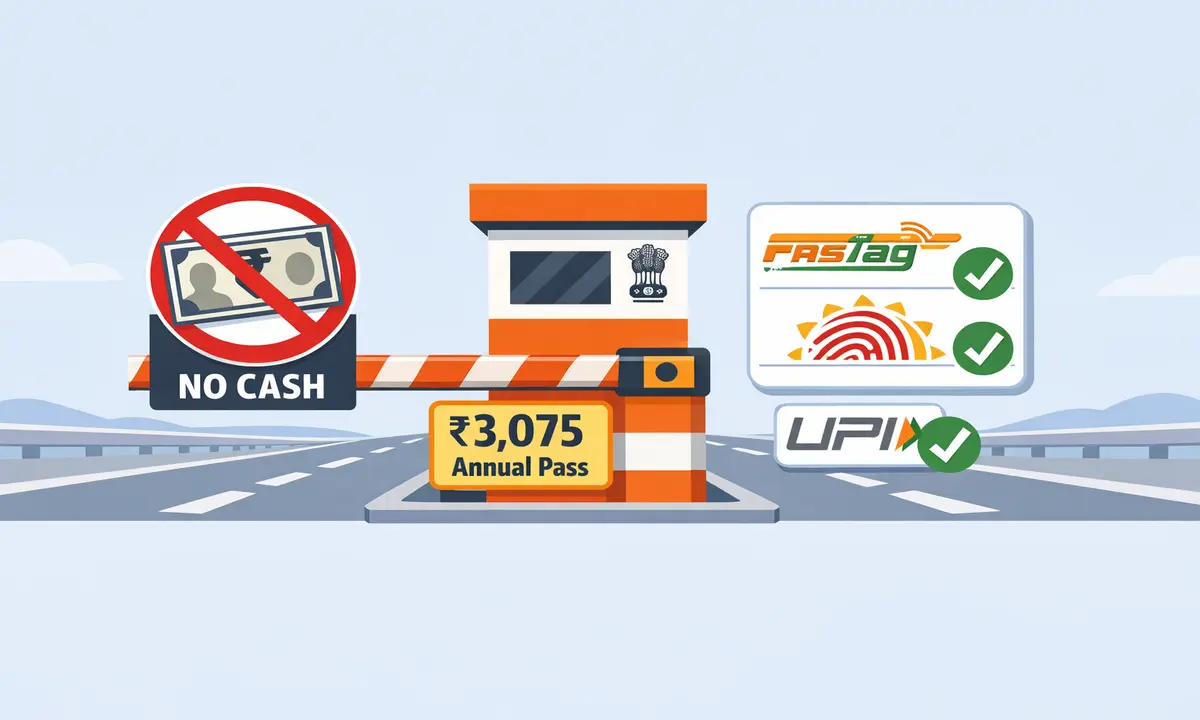
FASTag Annual Pass: ₹3,000 → ₹3,075. The government increased the fee by 2.5% for FY 2026-27. The pass covers approximately 200 toll plazas nationwide for one year or up to 200 trips, whichever comes first. For frequent highway travellers in Bihar, Uttar Pradesh, Maharashtra, and Karnataka, this pass remains cost-effective – but purchase before the old pricing window closes.
Cash payments at national highway toll plazas are now banned. From April 1, only FASTag or UPI will be accepted at toll booths. If your FASTag has expired, you will be turned away at participating plazas.
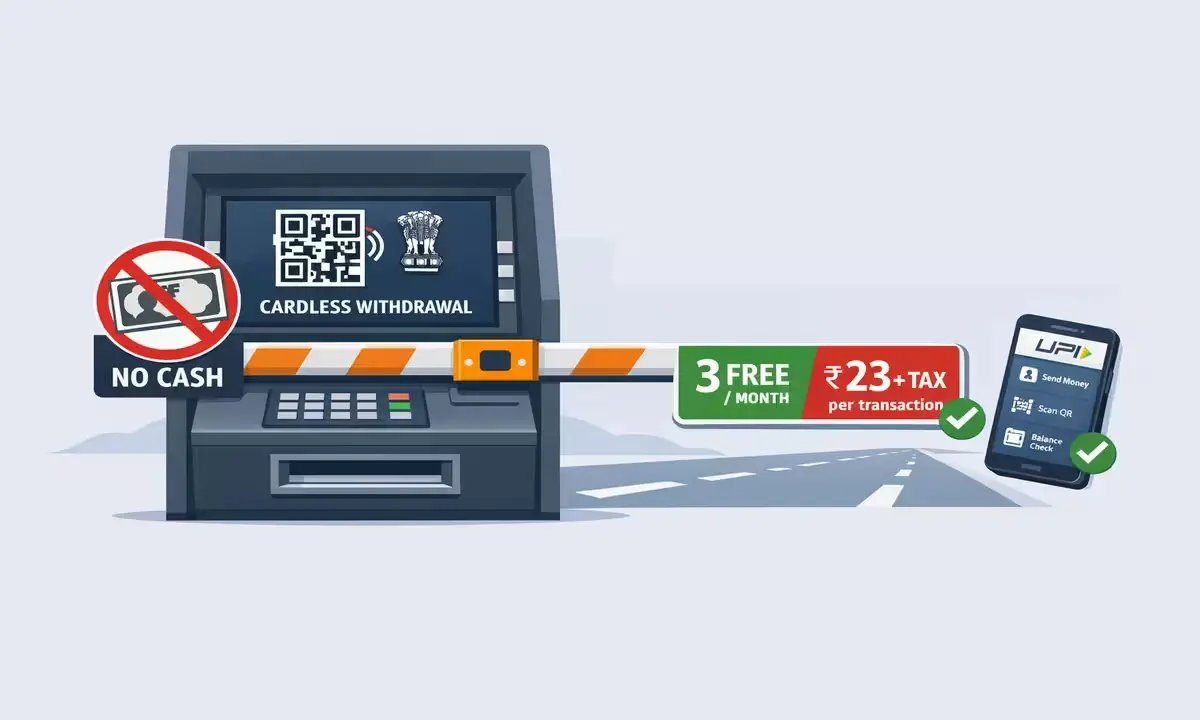
ATM charges: UPI-based withdrawals now count. From April 2026, UPI-based cardless ATM withdrawals are included in your monthly free transaction limit. Once you exceed the free limit, the charge is ₹23 + applicable taxes per transaction. Some banks are also revising daily debit card withdrawal limits — check with your bank directly.
RBI’s two-factor authentication mandate goes live. Banks and fintech platforms must implement two-factor authentication (2FA) for all digital transactions, with at least one dynamic factor (OTP or biometric). Expect slightly more friction on payments in April as systems update.
Act Now
Renew your FASTag Annual Pass at the NHAI FASTag portal (fastag.ihmcl.com) before 15 April 2026. Verify your linked mobile number – 2FA enforcement means an expired or unlinked number will block transactions.
Travellers on NH-31, NH-19, and NH-98 in Bihar – covering the Patna–Gaya and Patna–Muzaffarpur corridors — should verify FASTag validity before April 1 travel. Verified at The Federal, 29 March 2026. Confirm at fastag.ihmcl.com.
Frequently Asked Questions About April 1 2026 Rule Changes
Is income up to ₹12 lakh really tax-free from April 1 2026?
Yes – under the new tax regime effective April 1 2026, individuals earning up to ₹12 lakh annually pay zero income tax, thanks to an enhanced rebate under Section 87A of the Income Tax Act, 2025 (up to ₹60,000). Crucially, income tax slabs themselves have not changed for FY 2026-27. Salaried individuals with a standard deduction of ₹75,000 effectively see zero tax liability up to ₹12.75 lakh gross income. This benefit applies only under the new regime — the old regime retains the ₹5 lakh exemption via rebate.
Critical Warning
The ₹12 lakh exemption does NOT apply to special rate incomes — such as capital gains on equity (taxed at 12.5% LTCG) or F&O income. These are excluded from the rebate calculation. Source: CBDT (Tier 1), verified 31 March 2026.
For more on new vs old regime trade-offs, read our piece on new vs old income tax regime for FY 2026-27.
What new documents are needed to apply for a PAN card from April 1 2026?
From April 1 2026, Aadhaar alone is no longer accepted as proof of date of birth for PAN card applications or updates. This was announced by Common Services Centres (CSC), a government body under the Ministry of Electronics and IT. Applicants must now submit one of the following: a Class 10 certificate, birth certificate, passport, voter ID, driving licence, or a magistrate affidavit. New category-specific application forms have also been introduced. Existing PAN holders are not required to reapply unless making changes.
Pro Tip
Gather all documentation before visiting a CSC centre. New forms are available at the NSDL PAN portal: onlineservices.tin.egov-nsdl.com. Source: Common Services Centres, Government of India, verified 31 March 2026.
How do ATM withdrawal charges change from April 1 2026?
From April 1 2026, UPI-based cardless ATM withdrawals will be counted within your monthly free transaction limit. Once you exceed your free limit (typically 3–5 transactions/month depending on your bank), a charge of ₹23 plus applicable taxes applies per transaction. Some banks are additionally revising their daily debit card withdrawal limits for FY 2026-27 – contact your bank to confirm. The RBI’s concurrent two-factor authentication mandate means OTP or biometric verification is now required for ATM-linked digital transactions.
Pro Tip
Plan ATM usage carefully in the first week of April – limits reset and systems are updating. Check your bank’s app for your FY 2026-27 free transaction policy. Source: Angel One Market Research (Tier 2), verified 30 March 2026.
For a full breakdown of banking rule changes, see our article on bank charges and ATM rules from April 2026.
📋 The 2026 Bottom Line
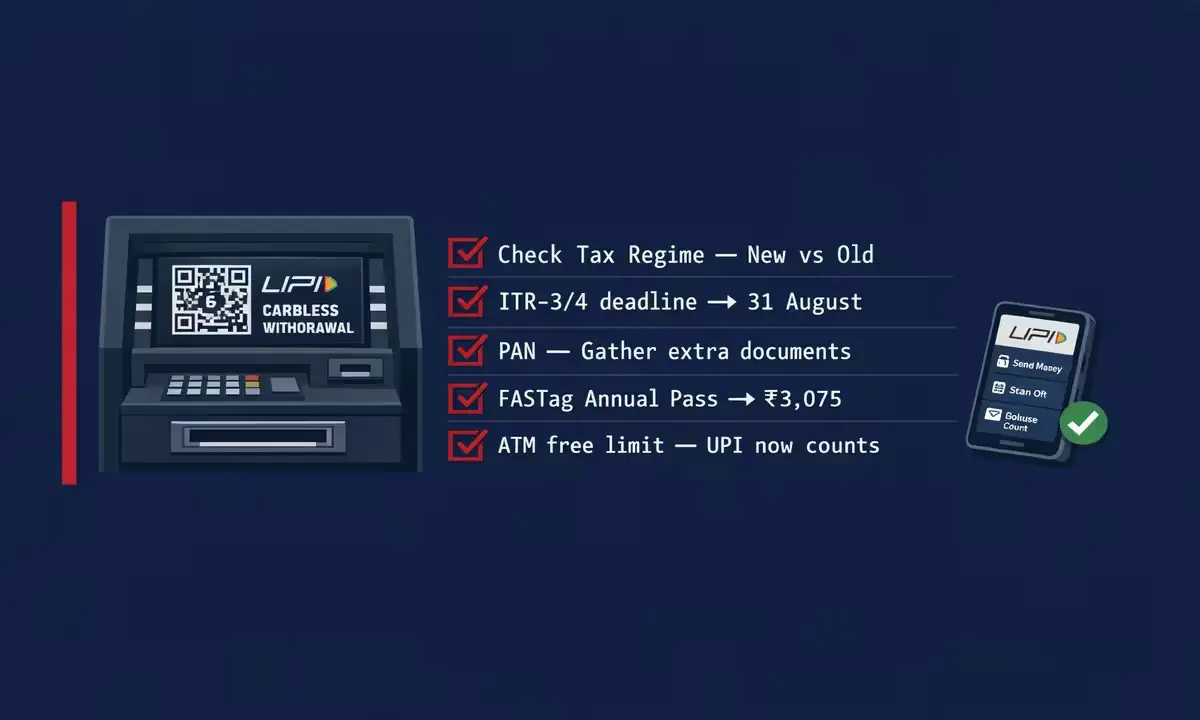
| Action | Detail |
|---|---|
| Primary Deadline | 1 April 2026 — all changes live. No grace period. |
| ITR-1 / ITR-2 deadline | 31 July 2026 (unchanged) |
| ITR-3 / ITR-4 deadline | 31 August 2026 (extended from 31 July) |
| Tax-free income limit | Up to ₹12 lakh — new regime, Section 87A rebate ₹60,000 |
| HRA 50% cities (new) | Bengaluru, Pune, Hyderabad, Ahmedabad added — 8 cities total |
| Form 16 replaced by | Form 130 (salary TDS certificate from April 2026) |
| PAN new requirement | Aadhaar alone insufficient — Class 10 cert / passport / birth certificate needed |
| FASTag Annual Pass fee | ₹3,075 (up from ₹3,000) |
| Highway cash payment | Banned – FASTag or UPI only at all NHAI toll plazas |
| ATM excess charge | ₹23 + taxes per transaction beyond free limit; UPI-ATM now counts in limit |
| STT on F&O | Increased – higher per-trade cost for derivatives from April 1 2026 |
| SGB capital gains | Tax-free only for original subscribers; secondary market buyers pay capital gains tax |
| ⚠ Critical Warning | Zero-tax under ₹12 lakh does NOT exempt you from filing ITR — late filing attracts Section 234F penalty |
| Official Tax Portal | incometax.gov.in |
| FASTag Portal | fastag.ihmcl.com |
| Cost / Fee | ITR filing via official portal: Free. FASTag Annual Pass: ₹3,075. |
Finance Editor — newshours18
Pravin Kumar covers personal finance, tax policy, and banking regulation for newshours18, with 6 years of experience tracking Union Budget announcements, CBDT circulars, and RBI policy changes affecting everyday Indian households.